

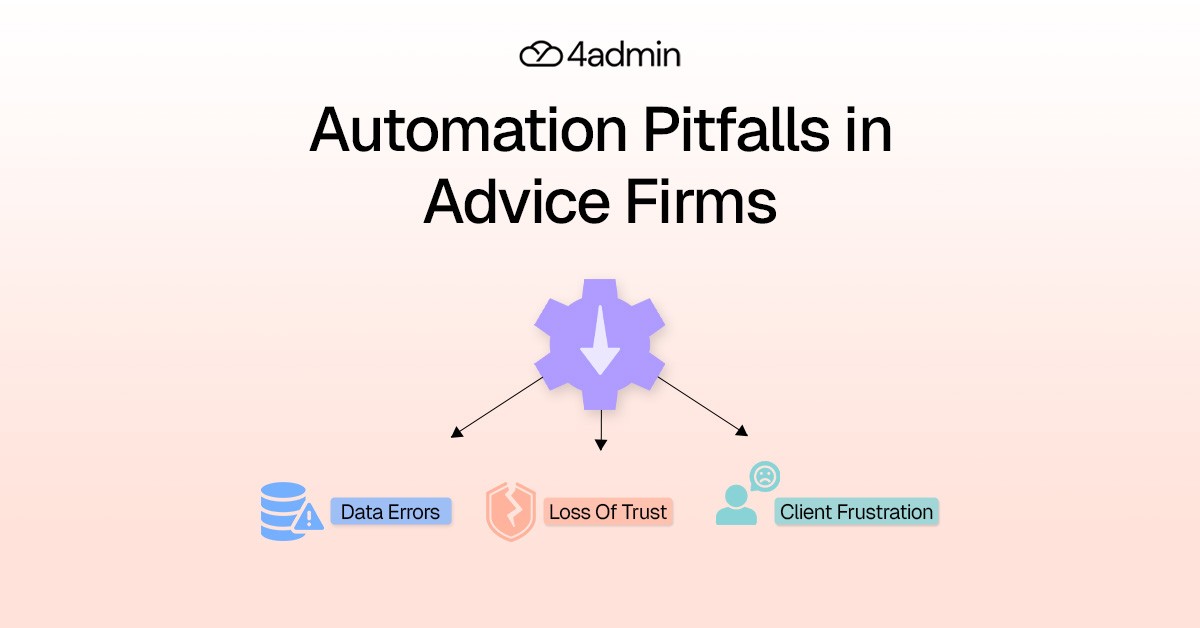
Automation failures in financial advice firms are not always the result of bad technology.
Most automation failures in financial advice firms happen for far more predictable reasons such as unclear processes, poor data, and fragmented systems.
When that happens, automation does not reduce workload. It increases friction. Teams spend more time fixing automated outputs, handling exceptions, and working around systems that were meant to help them.
Understanding where automation fails in advice firms is the first step to fixing it, and this blog helps you to do just that. As you continue to read, you'll find the patterns repeat across firms, regardless of size, platform, or tech budget. Thus, implying that the failures are not random. Instead, they are structural.
Where Automation Fails
Automation failures in advice firms typically happen in one or more of the 7 common areas as listed below:
1. Automating Broken or Undefined Processes
The most common automation strategy error is automating workflows that were never clearly defined in the first place.
In many advice firms:
Processes exist only in people’s heads
Different team members follow different versions of the same workflow
Inefficient steps are carried forward instead of removed
Variations and exceptions are handled manually outside the system
Automation in this environment simply codifies chaos. It creates handoffs of incomplete work, escalation of errors, and more frequent breakdowns when reality does not match the assumed process.
This is one of the most common process automation pitfalls. Automation does not fix a process mismatch. It amplifies it.
2. Poor Data Quality Undermines Everything
Another major reason automation fails in advice firms is poor data quality.
Automation depends on consistent, structured inputs. But many firms rely heavily on:
Incomplete CRM records
Email screenshots as data sources
Provider packs in unstructured formats
Manual re-keying between systems
With these data quality problems directly affecting automation, the result is automated outputs which are not trustworthy. As incomplete or inconsistent data goes back and forth, staff are forced to check, correct, or redo work that was supposedly automated.
This creates a familiar cycle:
Automation produces output.
Errors appear.
Humans step in to clean up.
Trust in automation drops.
At the end of the day, the quality of your data and automation issues are interconnected. Without improving data consistency at the source, no amount of tools can deliver reliable results.
3. Fragmented Systems and Weak Integration
Advice firms typically have complex tech stacks. CRMs, investment platforms, compliance tools, document storage, and provider data all sit in separate systems.
Integration challenges in automation appear when:
Automations stop at system boundaries.
Data does not flow cleanly between tools.
Teams are forced to bridge gaps manually.
Shadow spreadsheets and workarounds emerge.
All these fragmented systems turn automation into a patchwork. While each tool appears to be working great on its own, the overall workflow remains broken.
These integration issues cause tool sprawl, where firms add more automation tools to compensate for gaps instead of really pinpointing the underlying workflow design.
4. Lack of Clear Goals and Measurable Outcomes
Many automation failures in financial advice firms start before any tool is implemented.
Automation is often adopted because:
Other firms are doing it
Vendors promise efficiency gains
Internal pressure exists to “use AI”
But without clear goals, automation success cannot be measured.
Common signs of weak automation strategy can be like:
No baseline for time, cost, or error rates.
Success is not measured objectively.
ROI unclear even months after rollout.
Without defining your outcomes, automation governance is impossible given no one knows what success looks like, so no one can tell whether automation is actually working.
5. Ignoring the Human Element
The human element in automation setup is often underestimated.
Automation fails the fastest when people do not trust it.
This usually is visible through instances where:
Staff aren’t involved in process design.
Training and upskilling is insufficient.
Automation is perceived as a quiet replacement.
Employee adoption resistance is apparent.
When automation feels imposed rather than helpful, technology adoption barriers appear. Staff triple-check automated outputs, maintain parallel manual processes, or quietly revert to old processes.
Now, this is not resistance to technology, rather a response to automation that ignores how people work, how accountability is shared, and how risk is managed in advice firms.
6. Over-Automating Complex or Judgment-Based Work
Another common failure point is automation overreach.
Some tasks in advice firms are well suited to automation. Others are not.
Problems arise when firms attempt to:
Fully automate nuanced advice workflows.
Apply rigid systems to flexible decision-making.
Remove human judgement from complex scenarios.
All these attempts lead to poor exception handling and frustration for advisers and paraplanners. In the meantime, automation collapses whilst trying to keep up with edge cases, context, and professional judgement.
Automation works best when it supports decision-making, not when it tries to replace it.
7. Treating Automation as a One-Time Project
Automation is often treated as a setup task rather than an ongoing system.
Once automation goes live:
No clear owner is assigned.
Processes evolve but systems do not.
Errors and edge cases go unnoticed.
Scalability issues appear over time.
This lack of process ownership and automation governance causes gradual decay. Despite the automation working so well at the start, it eventually becomes unreliable as volumes grow, regulations change, and workflows shift.
Automation without governance does not fail instantly. It fails quietly, through increasing manual intervention and declining trust.
The Real-World Impact When Automation Fails
When automation fails in advice firms, its impact ripples across the business.
Common outcomes may include:
Minimal efficiency gains.
Increased manual work.
Staff disengagement and burnout.
Reversion to old, time-consuming processes.
Clients experience suffering through delays.
Failed automation often costs more than not using automation at all. Firms not only pay for tools, time, and disruption, but also end up with more complexity than they started with.
Manual Letters of Authority handling is a clear example. The hidden operational and financial impact of manual LoA processing shows how small inefficiencies compound across onboarding, transfers, and reviews.
How Advice Firms Can Fix Automation the Right Way
Fixing automation failures starts with revisiting the very foundation upon which automation was adopted.
Advice firms can fix automation by:
Mapping and standardising processes before automating.
Improving data quality and consistency at the source.
Integrating systems around a single workflow view.
Onboarding advisers, paraplanners, and admin teams early.
Starting with high-volume, rule-based tasks.
Setting up clear metrics and reviewing them regularly.
As a good automation starter, clarity is a must. Clear processes, clear data, clear ownership, and clear outcomes all combine to create the conditions needed for automation to work.
Fixing the Foundations Automation Depends On
Many automation failures trace back to back-office workflows that create the most friction.
4admin focuses on fixing those foundations by:
Structuring your unstructured provider and LoA data.
Integrating your fragmented systems into a connected workflow.
Reducing your team's manual intervention and rework.
Improving workflow visibility across advisers, paraplanners, and operations.
Supporting automation that complements human judgement instead of replacing it.
When the foundations are right, automation stops feeling fragile. It becomes dependable, scalable, and genuinely useful with workflow bottlenecks brought under control.
Conclusion
Where automation fails in advice firms, it is rarely because the tools are inadequate. It fails when automation is treated as a shortcut instead of a system that depends on process clarity, data quality, integration, and ownership.
Firms that fix these foundations first see automation deliver real gains in efficiency, compliance, and client experience.
The goal is not more automation, rather to get better outcomes with less effort.
FAQs
Why Does Automation Fail in Financial Advice Firms?
Automation fails in financial advice firms when broken processes are automated without clean data, clear ownership, or adviser buy-in.
What Are the Most Common Automation Mistakes Advice Firms Make?
Common automation mistakes include automating too much too fast and depending on manual workarounds.
Can Automation Replace Advisers or Paraplanners?
No. Automation supports by removing admin work, and not by replacing human involvement.
What Are the 4 D's of Automation?
The 4 D’s are Discover, Design, Deploy, and Deliver value through continuous optimisation.
What Are the 4 Types of Automation?
The 4 types are rule-based automation, RPA, workflow automation, and intelligent (AI-driven) automation.
How Can Automation be Improved?
Automation improves when processes are simplified first, data quality is enforced, and feedback loops are built in.
How to Track Automation Progress?
Automation progress is tracked using KPIs like time reduction, error rates, and manual effort saved.
Ready to automate your admin processes?
Learn how you can reduce admin backlog, ensure compliance, and increase capacity.