
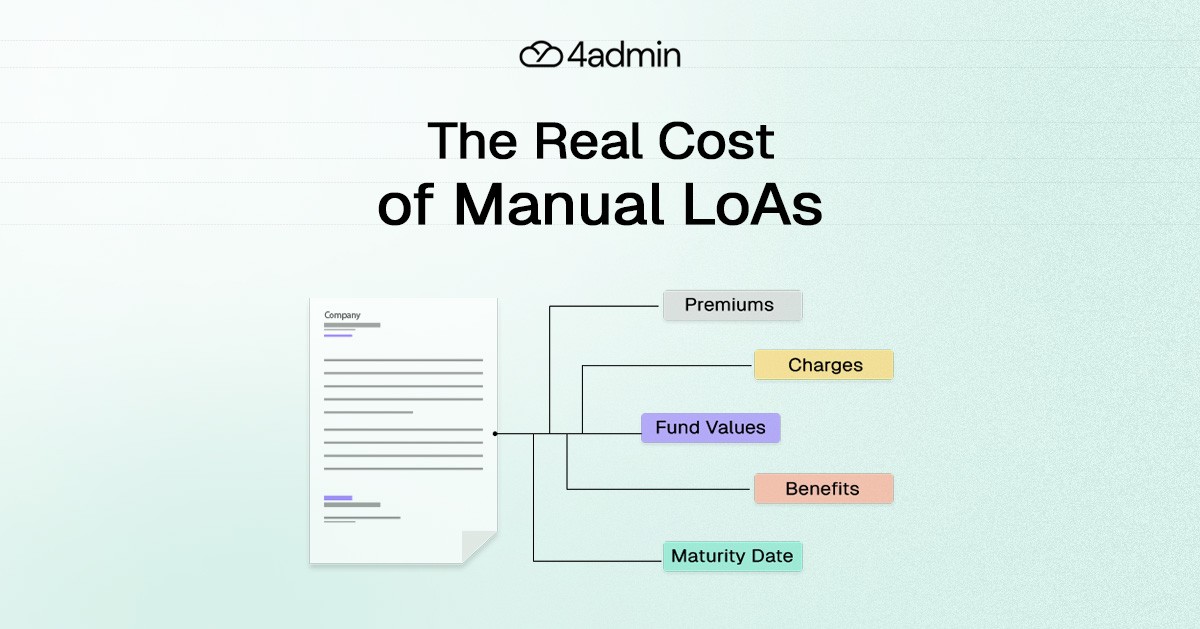
Manual Letters of Authority still look harmless on the surface with a few PDFs, some emails, and a bit of chasing. A task that feels routine and familiar.
But when firms step back and examine the hidden costs of manual LoA processing, the picture changes fast. What appears cheap and manageable is often quietly eroding efficiency, margins, team capacity and client experience.
This blog breaks down the true cost of LoA processing, beyond what shows up on a profit and loss statement, and helps decision-makers build a clear business case for change.
Why Manual LoA Processing Looks Cheaper Than It Is
Manual LoA processing feels inexpensive because most of the cost is buried inside existing roles, systems, and workflows.
There is no single invoice that says “LoA inefficiency.” Instead, costs are spread across admin hours, paraplanner time, adviser interruptions, delayed onboarding, compliance risk, and staff fatigue.
Because these costs are fragmented, firms underestimate the LoA processing costs and assume automation would be an added expense rather than a corrective one!
Direct Costs of Manual LoA Processing
Direct Labour Costs
The most obvious cost is time. Admin teams are manually:
Reading provider PDFs
Extracting data line by line
Re-keying information into CRMs
Identifying missing fields
Flagging follow-ups for later
Even conservative estimates show that direct labour costs stack up quickly when multiplied across hundreds or thousands of LoAs each year. Advisers and paraplanners are often pulled in to unblock issues, increasing the cost further.
What looks like “part of the job” is actually a recurring drain on productivity.
Paper and Postage Costs
Despite digital progress, many firms still rely on wet signatures annually, paper-based forms, and postal LoAs.
These create:
Paper and postage costs
Printing and scanning overhead
Storage costs for physical records
Although individually small, these expenses become material at scale, especially when combined with handling time and delays.
Technology Workarounds
Manual LoA processes often force firms into inefficient technology fixes:
Shadow spreadsheets
Shared inboxes
Manual trackers
Duplicated systems
These workarounds increase technology debt, introduce errors, and add maintenance overhead without solving the root problem.
Indirect Costs That Don’t Appear on Profit or Loss Statements
Onboarding and Advice Delays
Manual LoA processing directly causes onboarding delays.
When information arrives incomplete or late:
Advice cannot proceed
Reviews are pushed back
Revenue recognition slows
Clients wait longer for outcomes
These delays impact client experience and cash flow but rarely get attributed to LoA inefficiency.
Error Correction Costs
Manual data handling leads to mistakes such as missed datapoints, incorrect or outdated policy details and inconsistent records across systems.
These issues create error correction costs which comprise rework, internal reviews, and compliance checks. The time spent correcting errors more than often exceeds the time most firms believe to save by avoiding automation.
Follow-Up and Chasing Costs
Incomplete information triggers endless chasing:
Going back to clients
Emails and phone calls to providers
Internal reminders and escalations
These follow-up costs consume admin capacity and fragment focus. They also increase the risk that cases stall or fall through the cracks.
Opportunity Costs Leaders Rarely Calculate
The biggest cost is often what firms never measure. Every hour spent on manual LoA work is an hour not spent on:
Client-facing activity
Generating new business
Service improvements
Strategic initiatives
These opportunity costs limit growth, suppress revenue per adviser, and slow the firm’s ability to scale efficiently.
Compliance, Risk, and Reputational Impact
Consumer Duty Exposure
Manual LoA processes increase the risk of:
Incomplete data
Outdated information
Poor audit trails
This creates real exposure to Consumer Duty violations, especially when advice is based on partial or inconsistent information. The cost of remediation, oversight, and potential penalties far outweighs the perceived savings of manual processing. Inconsistent LoA data often sits at the centre of this compliance risk in advice firms.
Reputational Damage
Reputational damage is a direct consequence resulting from an eroded trust caused by delays, errors, and repeated follow-ups.
While clients are definitely not witnessing the LoA process firsthand, they end up feeling its effects as ripples across the slow onboarding, unclear updates, and delayed advice. Over time, this leads to dissatisfaction, client churn, and reputational damage that is difficult to reverse.
The Human Cost: Burnout and Retention
Manual LoA work is mentally draining.
Admin teams and paraplanners spend hours reading dense documents, switching between systems, and firefighting issues. This leads to:
Staff burnout
Higher recruitment costs
Training time loss
Loss of knowledge when experienced staff leave.
Retention issues further increase costs and reduce operational stability.
Why the True Cost of Manual LoA Is Higher Than You Think
When you combine:
Direct labour costs
Indirect costs
Opportunity costs
Compliance risk
Human impact
The true cost of LoA processing is far higher than most firms assume. Manual LoAs are not just inefficient. They are structurally expensive.
Making LoA Costs Visible with 4Admin
What Changes When LoAs Are Automated?
With automation, LoAs move from being a hidden cost to a measurable workflow.
Documents are read automatically, data is structured, missing fields are flagged early, and follow-ups are managed within a single process.
How 4Admin Supports Cost Clarity?
4Admin makes LoA work visible by:
Reducing manual data handling
Cutting follow-up and chasing costs
Eliminating re-keying across systems
Improving audit trails for compliance
This allows firms to clearly see their LoA automation ROI, rather than guessing.
The Result
Firms gain:
Faster onboarding.
Lower operational friction.
Improved turnaround times.
Reduced risk and burnout.
Most importantly, leadership can finally quantify the savings.
Understanding ROI from LoA Automation
ROI is not just about reducing headcount.
It comes from:
Lower processing time per LoA
Fewer errors and corrections
Faster revenue recognition
Reduced compliance exposure
Improved staff retention
When measured properly, LoA automation delivers sustained operational and financial returns.
A Simple Framework to Assess LoA Business Case
To assess your LoA business case, include:
Time spent per LoA by role
Volume of LoAs processed annually
Error correction and follow-up frequency
Delays to onboarding and advice
Compliance and reputational risk
Recruitment and training costs linked to burnout
This framework reveals the real cost baseline and highlights where automation creates value.
Conclusion
Manual LoA processing looks cheap because its costs are hidden.
But when firms account for labour, delays, errors, opportunity loss, compliance risk, and burnout, the economics change completely. Addressing the hidden costs of manual LoA processing is not about cutting corners. It is about building a more resilient, efficient, and scalable advice business.
FAQs
What are the hidden costs of manual LoA processing?
Processing LoA manually includes hidden costs like compliance risk, staff burnout, and reputational damage.
How much does manual LoA processing really cost?
An estimated cost is between £35 to £55. Costs are often several times higher than direct labour alone.
How does automation reduce LoA costs?
Automation cuts down manual handling, follow-up costs, error correction, and onboarding delays while improving auditability.
What is the ROI of LoA automation?
ROI primarily comes from the time saved, faster revenue, reduced risk, and improved staff retention.
Can manual LoA processing impact Consumer Duty compliance?
Yes. Incomplete or inaccurate data increases the risk of Consumer Duty breaches.
Does LoA automation reduce staff burnout?
Yes. Removing repetitive, low-value tasks improves workload balance and retention. Firms that automate LoA handling free up capacity, which supports sustainable growth. This is a key principle when scaling a financial advice firm without increasing headcount.
What costs should CFOs include in an LoA business case?
Direct labour, indirect costs, opportunity costs, compliance exposure, recruitment costs, and training time loss.
Are paper-based LoAs still cost-effective?
No. Paper and postage costs, storage costs, delays, and environmental costs make them potentially inefficient.
Ready to automate your admin processes?
Learn how you can reduce admin backlog, ensure compliance, and increase capacity.