
A signed LoA is not always an accepted LoA and that is where many advice firms lose time.
Your client may have signed the Letter of Authority, but if the provider does not accept the signature format, the request can still be rejected.
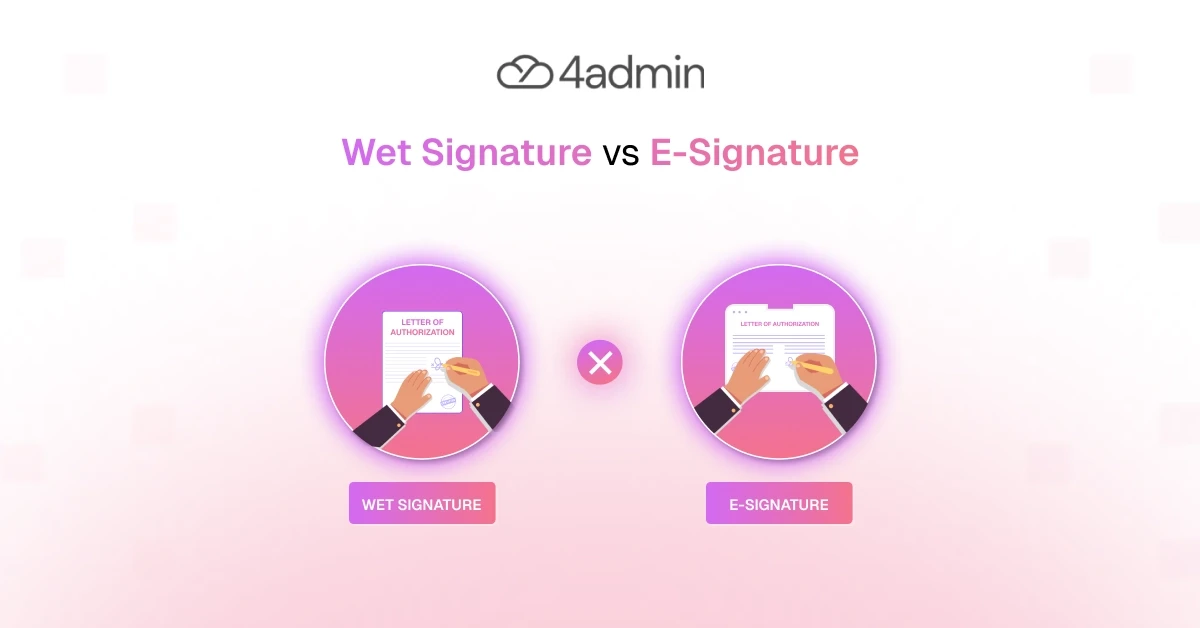
When it comes to Wet Signature vs E-Signature for UK advice firms, an essential question is whether the provider actually accepts the signed Letter of Authority and processes the information request without delay.
But provider signature acceptance is not always consistent. Some providers accept an e-signature Letter of Authority. Others still ask for a wet signature.
This blog helps you understand both the signature format and the provider-specific requirements behind each for your advice firm.
What is a Wet Signature?
A wet signature is a traditional pen-and-ink signature on a physical document.
In a financial advice context, a wet signature Letter of Authority usually follows this process:
The adviser or administrator prepares the LoA form
The client prints the document
The client signs it with pen and ink
The signed documentation is scanned, uploaded, emailed, or posted to the provider
Wet signatures are still commonly used because many providers are familiar with them.
They are also often seen as the safest choice when the provider acceptance policy is unclear. If a firm does not know whether an electronic signature will be accepted, requesting a wet signature can reduce the risk of provider rejection.
The downside is speed.
Wet signatures can create more manual work because they often depend on:
Printing
Scanning
Physical document handling
Manual verification
Emailing or posting signed documents
Chasing clients for returned paperwork
For advice firms dealing with high LoA volumes, this can slow down the wider information gathering process.
What is an E-Signature?
An e-signature, or electronic signature, is a digital method of signing an electronic document.
Common examples include:
A typed name
A signature drawn on a screen
A signature added through a digital signing platform
A signing process using tools such as DocuSign, Adobe Sign, Yousign, Dropbox Sign, or similar platforms
For advice firms, the main advantage of an e-signature Letter of Authority is speed.
The client can sign remotely from a phone, tablet, or laptop. There is no need to print, scan, or post the document.
This can support:
Digital onboarding
Faster client consent
Secure document transfer
Better client records
Quicker provider correspondence
A smoother document workflow
E-signatures can also make compliance checks easier, provided the firm keeps the right audit trail.
Wet Signature vs E-Signature: Core Differences
The difference between wet signatures and e-signatures is not only about paper versus digital.
It affects speed, tracking, document security, provider processing, and the risk of provider rejection, including:
Area | Wet Signature | E-Signature |
Medium | Physical pen and paper | Digital device, screen, or typed name |
Speed | Slower because it may require printing, scanning, or posting | Faster because documents can be signed remotely |
Convenience | Requires physical handling or posting | Can be signed from almost anywhere |
Tracking | Usually manual | Can include timestamps, IP addresses, completion certificates, and audit trails |
Security | Relies on paper storage and manual verification | Can include encryption, authentication, and tamper evidence |
Provider acceptance | Often accepted, especially by conservative or legacy providers | Accepted by many modern providers, but not universally |
Are E-Signatures Legally Valid in the UK?
Electronic signatures are generally legally recognised in the UK.
In many cases, they can be used to show that a person has agreed to, approved, or authorised a document.
But there is an important distinction:
Legal validity does not automatically mean provider acceptance.
A provider may still decide that, for its own internal fraud controls, security protocols, or signature validation rules, it needs a specific type of signed documentation.
This matters in regulated advice because firms are dealing with sensitive client information.
They need to think about certain factors including:
Client consent
Client records
FCA compliance
Data protection
GDPR compliance
Identity verification
Secure document transfer
Document authentication
So, while e-signatures may be valid in principle, the receiving organisation can still apply its own provider requirements before processing the LoA.
Why LoA Signature Acceptance Depends on the Provider
LoA signature acceptance usually depends on the organisation receiving the request.
UK financial and insurance providers, banks, pension administrators, platforms, life offices, and other institutions each have their own acceptance rules.
That means the same LoA may be accepted by one provider and rejected by another.
Provider-specific requirements usually depend on a few key factors:
The type of request: whether the LoA is for information only, gives wider authority, supports a transfer, or relates to re-registration.
The product involved: pensions, investments, insurance policies, platforms, and legacy products may all be handled differently.
The provider’s internal checks: including fraud controls, security protocols, identity verification, and signature validation.
The document format: whether the provider requires its own form or will accept an adviser-generated LoA.
The signing method: whether the provider accepts a wet signature, an e-signature, or only certain e-signature platforms.
The supporting evidence: whether an audit trail, completion certificate, or additional client verification is required.
For example, a provider may accept an e-signed LoA for a basic information request, but require a wet signature for a transfer-related instruction.
Another provider may accept e-signatures, but only where the advice firm uses an approved signing platform and includes the completion certificate.
This is why LoA signature requirements are not just about the signature itself. They are about the full submission process.
Many modern financial and insurance providers now accept e-signatures for certain LoA workflows.
This can include: pension providers, life offices, investment platforms, insurance companies, and provider portals. But acceptance is not universal. For advice firms, this creates a real operational issue.
It is not enough to know that e-signatures are common. Firms need to know whether the specific provider will accept the specific signature format for the specific LoA form being submitted.
Where E-Signatures Are Commonly Accepted
E-signatures are more likely to be accepted where the LoA is straightforward and the provider has a modern digital workflow.
Common examples include:
Information-only Letters of Authority
Standard business authorisations
Digital banking or platform workflows
Secure adviser portal submissions
LoAs signed through authenticated e-signature tools
Documents with completion certificates and audit trails
For a financial advice firm, this can make a noticeable difference.
Instead of waiting for a client to print, sign, scan, and return a document, the firm can send the LoA electronically and receive the signed documentation much faster.
But e-signatures work best when the process is controlled.
The firm still needs to:
Check provider requirements
Capture clear client consent
Retain the correct audit trail
Submit the document through the right channel
Where Wet Signatures May Still Be Required
Wet signatures may still be required where the provider, product, or document type carries a higher level of risk or formality.
In advice firm LoA workflows, this usually applies to:
Legacy or conservative providers
Older policies with stricter servicing rules
External transfers
Re-registration forms sent to third-party ceding companies
In these cases, providers may be less willing to rely on a basic electronic signature. They may need stronger evidence that the client has authorised the request and that the signature can be verified.
For advice firms, this means a wet signature Letter of Authority is still relevant.
It may not be the fastest option, but it can still be the required route for certain provider workflows.
The risk comes when firms assume that one signing method works everywhere.
This assumption can lead to provider rejection, manual re-submission or longer turnaround time.
Why Some E-Signed LoAs Still Get Rejected
Even where a provider accepts e-signatures in principle, the submitted document may still fail the provider’s acceptance checks.
Common rejection reasons include:
The e-signature lacks an audit trail
No completion certificate is attached
The document was signed using a basic PDF editor
A typed name is not accepted by that provider
The signer’s identity cannot be verified
The client email does not match provider records
The LoA form is not provider-specific
The wording does not give clear client authorisation
The provider requires wet ink for that request type
The LoA was submitted through the wrong channel
Personal or banking information was sent insecurely
These issues create avoidable delays.
A rejected LoA often means the administrator has to:
Contact the client again
Explain the issue
Arrange a new signature
Resubmit the request
Restart the provider processing timeline
Update internal client records
Chase the provider again later
That is why signature validation should happen before submission, not after rejection.
Best Practices Before Submitting a Letter of Authority
Before submitting a Letter of Authority, advice firms should check both the signature format and the provider-specific requirements.
A practical checklist should include:
✅ Checking the provider’s LoA guidelines before submission.
✅ Using the provider’s own LoA template where required.
✅ Confirming whether wet signature or e-signature is accepted.
✅ Using authenticated e-signature platforms where possible.
✅ Including the audit trail or completion certificate.
✅ Using secure adviser portals or secure email.
✅ Verifying the right signatory has signed the LoA.
✅ Making sure the LoA wording gives clear client consent.
✅ Keeping a record of what was signed, when, and how it was submitted.
✅ Tracking rejection reasons for future submissions.
It is also useful to maintain an internal record of provider-specific signature requirements.
For firms handling high volumes of provider correspondence, this can reduce rework and improve consistency across the admin team.
It also supports a clearer audit trail because the firm can show:
What was submitted
When it was submitted
How it was signed
Which provider rules were followed
What evidence was included
Why Signature Requirements Matter for Advice Firms
Signature requirements matter because LoA delays affect more than paperwork.
When the wrong signature format is used, advice firms may face:
Provider rejection and re-submission
Client re-signing requests
Extra back-and-forth with providers
Delayed provider packs and slower information gathering
Longer onboarding and transfer timelines
Frustration for clients, advisers, and support teams
These delays can make the whole advice process feel slower than it should.
Advisers are left waiting for provider packs. Administrators spend time chasing missing information. Clients may wonder why they need to sign the same document again.
From a compliance perspective, firms also need clear records around client records, data, documentation, and audit trails.
Poor LoA admin can make the audit trail harder to follow and increase the risk of mistakes.
This makes Wet Signature vs E-Signature not just a signing question, rather an operational question.
Also read: Why Most LoAs Fail on the First Submission?
Why Provider Acceptance Matters More Than the Signature Format
Whether the signature format matches the provider’s document acceptance criteria for a specific Letter of Authority is a critical aspect of the entireLoA submission process.
For example: one provider may accept a DocuSign LoA with an audit trail. Another may require a scanned wet signature. Another may reject e-signatures for transfer-related requests altogether.
This makes LoA admin difficult to manage manually at scale.
Also read: The Hidden Costs of Manual LoA Processing
As case volumes grow, manual checking becomes harder to control:
Provider requirements may change.
Different products may have different rules.
Some may request additional evidence.
Others may need a specific submission process.
That is why provider acceptance matters more than the signature format itself.
The firms that reduce LoA delays are usually the ones that treat signature requirements as part of a structured provider workflow, not as a one-off signing task.
How 4admin Helps Advice Firms Manage Provider-Specific LoA Signature Requirements
4admin helps advice firms manage the practical reality behind LoA submission requirements.
Instead of relying on manual checks, spreadsheets, inbox trails, and repeated provider correspondence, firms can use 4admin to bring more structure into the LoA workflow.
That includes helping teams:
Manage provider-specific requirements
Track LoA submissions
Reduce avoidable rejections
Keep clearer client records
Capture the right audit trail
Improve visibility across provider requests
Reduce manual provider correspondence
Inform users whether wet signature or e-signature is supported across providers.
The goal is simple: understand what each provider needs and submit the LoA correctly the first time.
When signature requirements are managed as part of the wider provider workflow, LoA admin becomes easier to control.
Conclusion
For advice firms, the issue is not simply choosing between a wet signature and an e-signature. The real challenge is knowing what each provider will accept, submitting the LoA correctly, and keeping a clear audit trail.
When signature requirements are managed as part of a structured LoA workflow, firms can reduce rejections, avoid unnecessary rework, and move provider information requests forward faster.
As LoA volumes grow, manual processes become harder to manage. 4admin gives firms a faster, more efficient way to handle provider documents through Letter of Authority Automation.
Book a free call and see how your team reduces administrative workload while improving turnaround times.
FAQs
Does the FCA require wet signatures for Letters of Authority?
No, the FCA’s rules do not explicitly require wet-ink signatures for agreements or LoAs and do not prevent using electronic signatures.
How can I check a provider’s LoA signature policy quickly?
Check the provider’s adviser portal or LoA guidance page first, then confirm via their adviser support email/phone or a trusted provider matrix before submission.
What must I include with an e-signed LoA to avoid rejection?
Include the provider-specific LoA form, an authenticated e-signature with a completion certificate, and a clear audit trail showing timestamps, signer identity, and submission channel.
When should I request a wet signature instead of an e-signature?
Use wet ink for transfer/re-registration instructions, legacy providers, documents requiring witnessing or notarisation, and when the provider’s policy explicitly requires wet-ink for that request type.
What audit trail details do providers typically check?
Providers check timestamps, IP addresses, signer email/identity verification, document hash/tamper evidence, and the completion certificate from the e-signature platform.
How to keep compliant audit trails for e-signed LoAs?
Store the signed LoA plus its completion certificate and full audit trail (timestamps, IP, signer auth, document hash) in your secure DMS/CRM with GDPR-safe access controls and link it to the client record and submission metadata.
Ready to automate your admin processes?
Learn how you can reduce admin backlog, ensure compliance, and increase capacity.