
Your financial adviser can’t give proper advice until they know what you already have.
Before recommendations are made or plans are updated, advisers need accurate information about your existing pension schemes, insurance policies, investments, or utility accounts. That information is held by product providers, not by your adviser. And without formal permission, it cannot be shared.
A Letter of Authority solves this problem by allowing providers to release information safely and with your permission.
In this guide, we'll explain what a Letter of Authority is, how it works, what it allows, why requests get rejected, and how firms can manage LoAs more efficiently.
What is a Letter of Authority (LoA)?
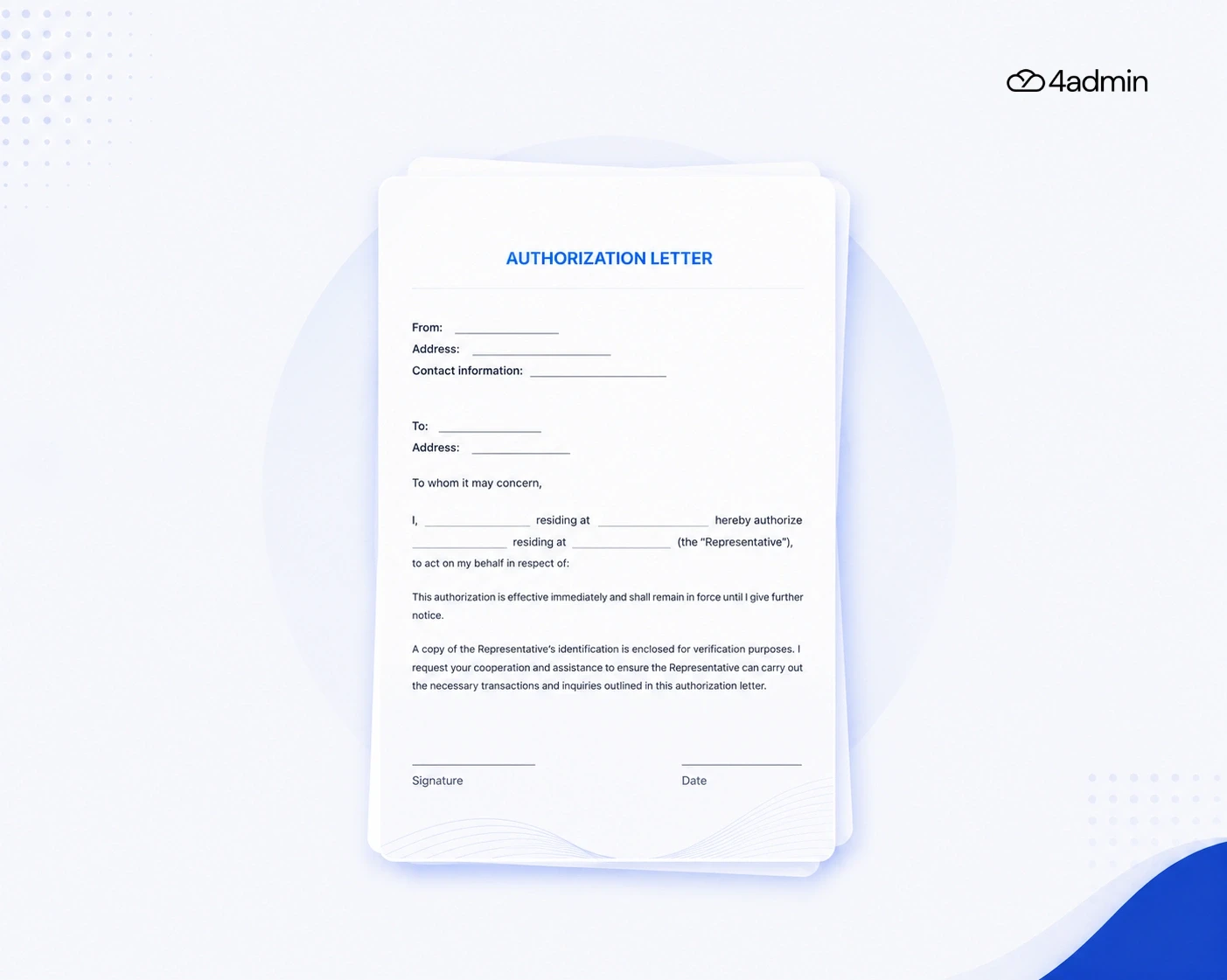
A Letter of Authority (LoA) is a signed legal document that gives a named third party permission to access information, communicate with organisations, or carry out specific tasks on your behalf for a clearly defined purpose.
It is commonly used across financial services, pensions, utilities, legal services, and business administration whenever information needs to be shared securely with an authorised third party.
In financial advice, an LoA is usually used to collect information rather than make decisions. Advisers use that information to understand your existing financial position before making recommendations.
Unlike a Power of Attorney, an LoA does not grant broad legal powers or decision-making authority. It only allows the activities specifically outlined within the document.
Third-party providers usually include pension providers and administrators, insurers, and other financial product providers.
Overall, an LoA clearly defines:
What information can be requested
Who can request it
How long the authority remains valid
Common Uses of Letter of Authority
The exact purpose of letter of authority changes depending on the situation. For example, an adviser requesting a pension valuation, or a broker accessing energy billing records. But the principle remains the same: giving a trusted third party permission to access information or act within a clearly defined scope.
Some common uses include:
Financial Advice: Allows advisers to request pension, investment and policy information for planning and recommendations. For example, requesting a current pension valuation.
HMRC or Tax: Allows accountants and tax advisers to access records or communicate with HMRC on behalf of clients. For example, querying a client's tax code.
Utilities or Brokers: Allows energy consultants and brokers to access usage history, billing records, and contract details when comparing suppliers or negotiating renewals. For example, comparing business energy tariffs.
Legal and Estate Matters: Used for probate, estate administration, and managing or transferring assets. For example, closing a deceased person's bank account.
Corporate and Administration: Allows employees, consultants, or representatives to communicate with suppliers, regulators or service providers on behalf of a business. For example, negotiating a supplier contract.
For clarity, this guide focuses primarily on Letters of Authority used within financial advice and wealth management.
What a Good LoA Includes (6 Key Components)
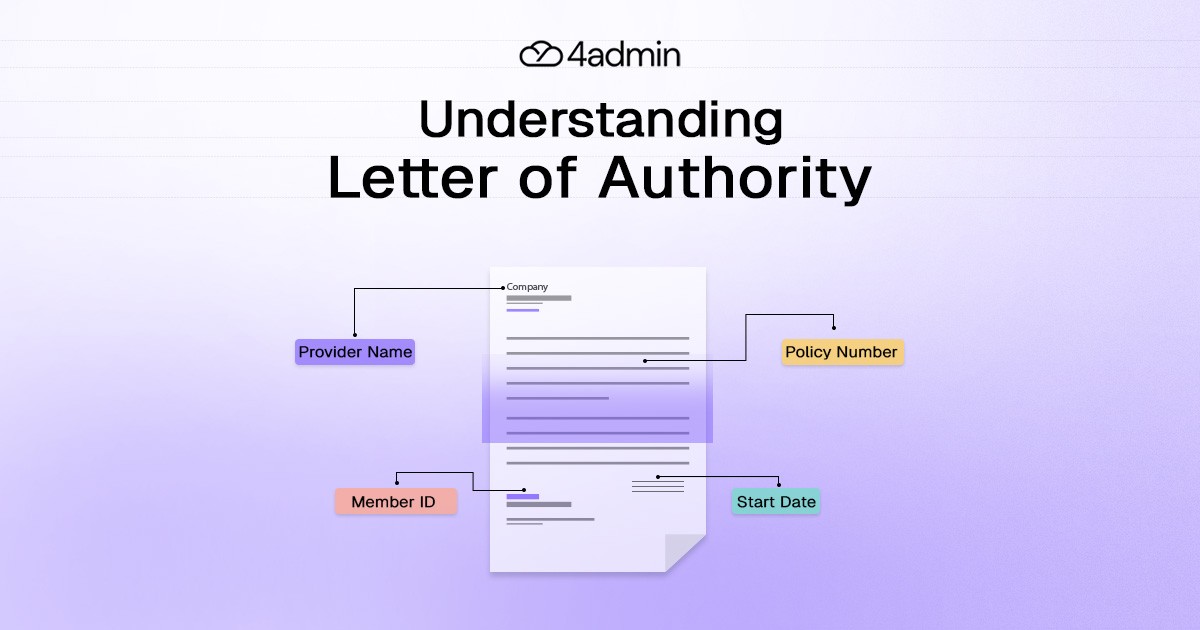
A good LoA mainly includes client details, authorised party details and a clear scope of authority, along with a few other specifics providers expect to see before they'll act on it. Missing even one of these six elements is a common reason LoAs get delayed or rejected.
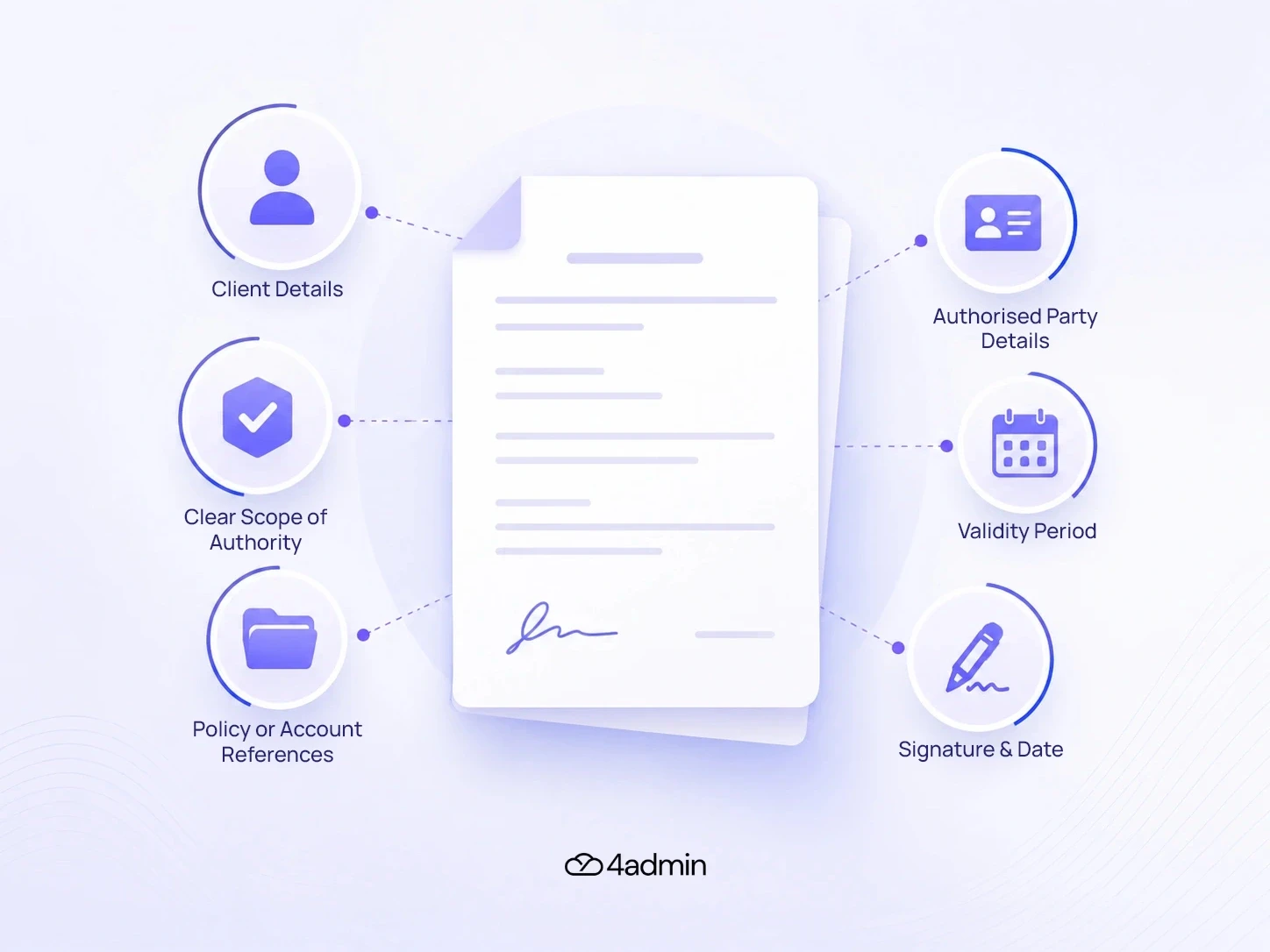
Client details: Full client name, date of birth and address (matching provider records)
Authorised party details: Adviser or firm name and FCA registration details (if applicable)
Clear scope of authority: A specific description of what the authorised party is permitted to do. For example, ranging from a valuation request to a transfer instruction
Policy or account references: Policy numbers, plan identifiers, or account details where available
Validity period: A clear start and end date for the authority. For example, most providers treat 12 months as the standard window before a fresh LoA is needed.
Signature and date: A valid client signature (wet or digital, as required) and signing date
Sample Letter of Authority Template
You can use the following template as a guide when creating a Letter of Authority for financial advice and information gathering purposes.
[Client Name]
[Client Address]
[Email address or Phone Number]
[Date]
[Provider Name]
[Provider Address]
Dear [Recipient Name],
I, [Client Name], hereby authorise [Adviser Name] of [Advice Firm Name] to act on my behalf from [Start Date] until [End Date] in relation to the purpose stated in this Letter of Authority.
This authorisation includes permission to:
Permission or responsibility 1
Permission or responsibility 2
Any additional permissions or responsibilities
This authority is intended for information gathering purposes only and does not permit changes to policies, transfers, withdrawals, or financial decisions to be made on my behalf.
If you need any further information or verification, please contact me using the details provided above.
Thank you for your cooperation and assistance.
Yours sincerely,
[Client Signature]
[Client Name]
How to Write a Letter of Authority (LoA)
In most cases, your adviser or provider will prepare the LoA for you to review and sign. But there are situations where you may need to prepare one yourself.
To write an effective LoA, follow these key steps:
Make sure to include full name, address, and contact details of both your business (or you personally) as well as the authorised third party.
Make clear who is giving permission and who is the one receiving it.
Make clear what actions the third party can take, including how much access they have (for example, can they only request information or do they have additional permissions?).
If available, add policy numbers, account references, or provider details.
Mention how long the Letter of Authority will remain valid.
Make sure the document is signed and dated by the person who has authorisation.
When it is possible, use templates specific to the provider or official company letterhead that are available. This can help reduce chances of being rejected.
Why LoAs Get Rejected and How to Fix Them
Most Letter of Authority delays happen because of missing information or provider validation issues rather than the request itself.
Issue | Reasons Behind Rejection | How to Fix It |
Client details | Details don’t match provider records | Ensure name, address, and date of birth exactly match provider records |
Policy references | Missing or incorrect policy numbers | Include correct policy or account numbers as held by the provider |
Signature | Signature type not accepted | Confirm signature type (wet or digital signature) before sending |
Scope of authority | Too broad or unclear | Clearly state what information can be requested |
Validity | Expired or undated LoA | Include a signing date and validity period |
Provider format | Wrong or generic template used | Use the provider’s required template |
The above issues often lead to unnecessary processing delays.
For practical steps to avoid these issues and improve turnaround times, see our guide on How to Reduce LoA Processing Time.
Why Do You Need a Letter of Authority?
Most providers will not share information without written consent because of privacy laws and data protection rules.
A Letter of Authority helps in this regard because it:
Gives formal consent for information to be shared
Allows providers to release data legally
Prevents unauthorised access to sensitive information
Keeps final control with the account holder
Without an LoA, advisers and brokers often cannot access the details needed to help.
Benefits of a Letter of Authority
Efficiency: Speeds up the process of collecting information from providers
Accuracy: Ensures data comes directly from providers and is up to date
Security: Limits access to authorised parties only
Clarity: Clearly defines what can be requested and for how long
Better advice: Supports informed and suitable financial recommendations
Compliance: Creates a clear record of consent and authority for regulatory and data protection purposes.
What Information Can Be Requested Under an LoA?
Depending on the scope of the authority, advisers can usually request:
Policy start dates and benefit details
Current values and contribution history
Fund holdings and asset allocation
Fees, charges, penalties, guarantees
Exit terms and special conditions
Servicing rights (if included in the authority)
This information gives advisers a more complete picture of your financial position. And this is essential for suitable advice.
What a Letter of Authority Does Not Allow
A Letter of Authority is not a blank cheque.
It does not allow someone to:
Move or transfer money
Make withdrawals
Change investments
Cancel or amend policies
Sign contracts (unless clearly stated)
LoAs are also time-limited. The validity period is stated in the document and is commonly around 12 months. After expiry, a new LoA may be required.
How a Letter of Authority Works (Step by Step)
Here’s the step-by-step process of how an LoA works:
Step 1: Information Identified
The adviser identifies what pensions, insurance policies, or investments their client has.
Step 2: LoA Prepared
The LoA is created using a provider-specific or firm-approved template.
Step 3: Client Signs
The client signs using a wet or digital signature, depending on provider requirements.
Step 4: Submission
The LoA is sent via email, provider portal, or post to the provider.
Step 5: Provider Verification
The provider confirms the client’s identity and authority to release the information.
Step 6: Provider Response
Policy information is returned, often as PDFs or valuation letters to the adviser.
Step 7: Adviser Updates Records
The adviser uses the information to update the fact find and CRM records and gives advice.
What Does an LoA allow an Adviser to Do
In financial services, an LoA is needed before an adviser or company can get in touch with providers for you.
The specific permissions rely on what is outlined in the document. But generally, they are restricted to accessing information instead of making decisions.
In most cases, an LoA allows your adviser to:
Access Information: An LoA allows your adviser to ask providers for details. This includes policy values, contributions, charges, and contract dates.
Review Your Existing Plans: Advisers can examine your pensions, investments, and insurance policies to comprehend costs, terms, and coverage.
Collect Important Financial Data: They have the capability to collect essential data like fund holdings, performance, and benefit details.
Direct Communication with Providers: Advisers can have direct conversations with providers, handle queries, and do follow up without requiring your involvement.
Support Financial Advice: With accurate data, advisers can assess your condition and give suitable recommendations.
Manage Servicing (only if agreed): Sometimes, advisers may take control of ongoing discussions with providers. But this can happen just when it is clearly permitted in the LoA.
Letter of Authority vs Power of Attorney
A common misconception is that a Letter of Authority allows advisers to act on your behalf. It doesn’t.
Letter of Authority: Allows a third party to request specific information only.
Power of Attorney: Grants legal authority to act on your behalf, which may include making financial decisions too.
The confusion usually comes from the word “authority”. LoAs allow access to information, not action.
Aspect | LoA | PoA |
Purpose | Access information or manage specific tasks | Make legal and financial decisions |
Scope | Limited and clearly defined | Broad and wide-ranging |
Decision-making Power | No (Unless explicitly stated) | Yes |
Typical Use | Financial advice, utilities, admin tasks | Long-term legal or financial authority |
Legal Impact | Lower | High |
How to Revoke a Letter of Authority (LoA)
To revoke an LoA at any time, follow the steps below:
Issue written notice: Send a signed written notice stating that the Letter of Authority is cancelled and from which date.
Notify the authorised party: Inform the adviser, broker, or agent in writing.
Inform third parties: Notify any providers or third parties that relied on the Letter of Authority.
Use proof of delivery: Use email confirmation or recorded delivery where possible.
Notarise if required: Notarise the revocation if the original LoA was notarised.
Once revoked, providers should stop releasing information under that authority.
LoA, GDPR, and FCA Compliance
Under UK GDPR, personal data shared through an LoA must be handled lawfully and only for its intended purpose.
Under the FCA’s Consumer Duty, firms are expected to act to deliver good outcomes for clients, which includes basing advice on appropriate and sufficiently accurate client information.
Key principles include:
Secure storage of client data.
Controlled access for authorised staff only.
Clear retention periods.
The ability for clients to withdraw consent at any time.
LoAs support good advice only when data is handled properly.
Servicing Rights and Information Access
Servicing rights define who can request ongoing valuations, updates, and policy information from providers.
Why this matters:
It avoids repeated LoA requests
It supports smoother annual reviews
It reduces delays when information is needed quickly
Important to note: servicing rights still do not allow changes to policies, withdrawals or transactions.
A Quick LoA Checklist to Avoid Delays and Rejections
Before sending:
Confirm client details match provider records
Verify policy or account numbers
Clarify the exact scope of information needed
Ensure the correct provider template is used
Check the required signature type
After sending:
Record submission date and method
Track provider responses
Follow up if needed
Store responses securely in the client file
Streamlining LoA Processing with 4admin
Managing LoAs manually is where most delays and errors occur.
Provider PDFs arrive in multiple formats. Each piece of information demands to be read, checked, and rekeyed. Missing details aren’t usually spotted until you're halfway through the process.
Platforms like 4admin remove the slowest parts of this workflow through a digital LoA solution that automatically reads LoA responses, even scanned or poorly formatted PDFs, and uses LoA automation to extract the relevant data into a clear, structured view.
Missing fields are recognized early. Clean and structured data syncs directly into your CRM without rekeying or double-handling.
The result? Faster LoA turnaround, fewer errors, and a calmer, more productive workflow for your paraplanners and admin teams.
Final Verdict
A Letter of Authority is a simple document that plays a crucial role in good financial advice. It allows advisers and representatives to gather the information needed to do their job well. When drafted clearly, it supports accurate advice and smooth processes. When handled poorly, it causes delays and frustration. So, understanding how an LoA works helps you stay in control while saving time.
Frequently Asked Questions
How long is a Letter of Authority valid for?
A Letter of Authority is typically valid for 12 months from the date of signing. But whenever a different duration applies, like 6 months or until a specific task is completed, this should be clearly stated in the document.
Who can sign a Letter of Authority?
A Letter of Authority must be signed by a person with legal authority, such as the account holder, a business owner, a company director, an authorised signatory, or a court-appointed executor. Related Resource: Wet Signature vs E-Signature on a Letter of Authority
What information does a Letter of Authority include?
A valid Letter of Authority usually includes the details of the person giving authority, the authorised party, a clear description of what is permitted, relevant account or policy references, the start and end date, and a signature with date.
What should I check before signing a Letter of Authority?
You should check the scope of information being requested, the duration of the authority, and confirm that it only allows information access, not account changes.
What information can a provider share under a Letter of Authority?
A provider can share only the information clearly specified in the Letter of Authority, such as policy details, values, charges, and benefit information, etc.
Do providers accept digital signatures on LoAs?
Some providers accept digital signatures, while others still require wet signatures. This depends on the provider.
Is it safe to sign a Letter of Authority?
Yes, it is generally safe to sign a Letter of Authority if it clearly states who is authorised, what they can do, and how long it lasts. It usually allows access to information only and does not give control over your accounts. Always read it carefully before signing.
Why are provider response times so slow after I sign an LoA?
Delays usually happen because of incorrect or missing details, unclear authority scope, signature issues, or provider-specific processing requirements.
Can I cancel or withdraw a Letter of Authority?
Yes. You can cancel or withdraw a Letter of Authority at any time by providing written notice to the authorised party and any relevant providers. Once revoked, providers should stop sharing information under that authority.
Ready to automate your admin processes?
Learn how you can reduce admin backlog, ensure compliance, and increase capacity.