
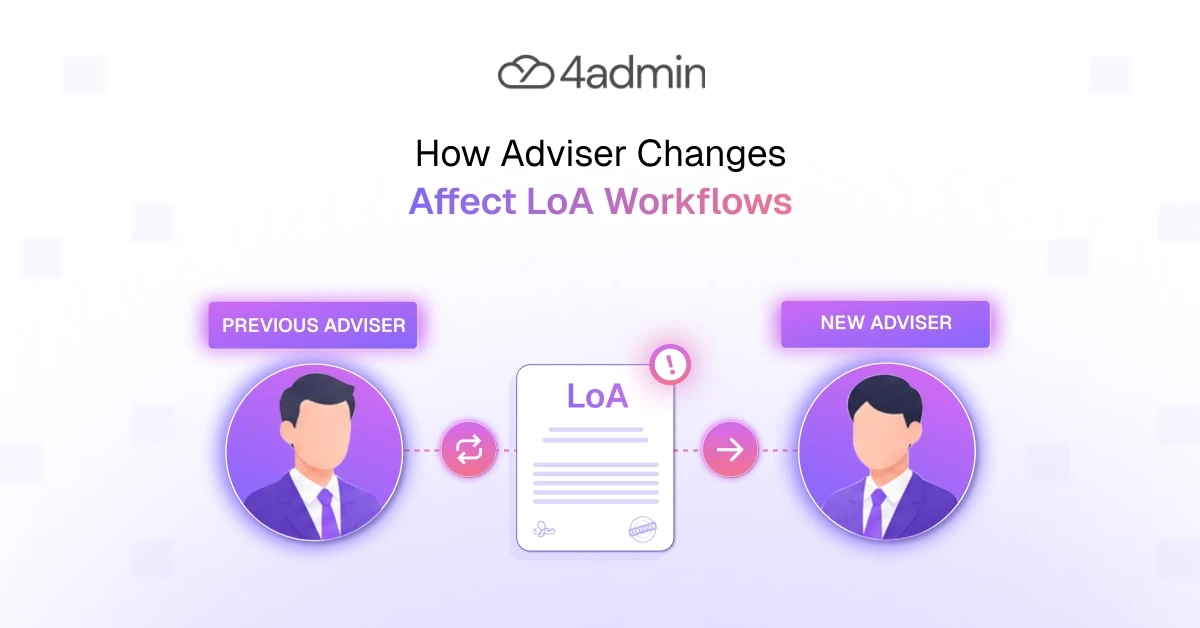
A client changing adviser should not bring the LoA workflow to a halt, but it often does. What looks like a simple adviser update can quickly turn into a chain of provider checks, new documentation, data access questions, servicing rights updates, and CRM changes.
A common question is: does changing financial adviser require a new Letter of Authority? The answer depends on the provider, the existing authority, the adviser appointment, and whether the client is staying within the same firm or moving to a new advice firm.
For advice firms, the real issue is keeping the process moving without losing visibility, delaying reviews, or weakening the audit trail.
This blog helps to explain how adviser changes affect LoA workflows and what advice firms need to manage more effectively internally.
Why Adviser Changes Affect LoA Workflows
A Letter of Authority gives an advice firm, adviser, or authorised party permission to request information from providers on behalf of a client.
When the adviser changes, providers may need to confirm who now has authority to act. They may check the client instruction, adviser registration details, signed documentation, identity verification, and whether the new adviser is linked to the firm asking for information.
This matters because LoA workflows depend on provider acceptance. Even if the client relationship has changed internally, the provider may still have the previous adviser or previous firm recorded on their system.
That can slow down information requests, provider correspondence, adviser onboarding, and the wider client review process.
When Adviser Changes May Require a New Letter of Authority
A new letter of authority for financial adviser changes will be required if the provider needs fresh client authorisation before releasing account or financial information to a new adviser.
This is more likely when:
The client is moving to a new advice firm
The previous adviser is no longer authorised to act
The LoA names a specific adviser rather than the wider firm
The existing LoA was limited to information gathering only
The firm is requesting a transfer of agency or servicing rights
The provider has specific acceptance criteria for signed documentation
Some providers may accept an existing authority if the client remains within the same financial advice firm. Others may require a new LoA form or additional client instruction before updating adviser access.
This is why changing financial adviser Letter of Authority workflows are usually not handled in one standard way across every provider.
Key Workflow Areas Affected by Adviser Changes
Adviser changes can touch several parts of the LoA and provider response process. The issue is not only the document. It is the admin around the document, including:
Data Access Permissions
The firm needs to confirm who can access client records, policy details, account information, and provider correspondence.
If the authority is linked to the previous adviser, the provider may not release information to the new adviser until updated documentation is received and checked.
This can delay the information gathering stage and create gaps in the advice process.
Provider Verification
Providers usually need to verify that the person or firm requesting information has the right authority.
That may involve checking the client authorisation, adviser registration details, firm details, identity verification, and whether the LoA matches their provider requirements.
Small differences in provider acceptance criteria can create delays, especially when each provider asks for information in a different format.
Adviser Appointment
When a client appoints a new adviser, the advice firm may need to update internal records and provider-facing documentation.
The adviser appointment needs to be clear, especially where the client has withdrawn authority from the previous adviser or moved to a next adviser.
Without clear signed documentation, the provider may not accept the new adviser’s authority to act.
Transfer of Agency
A transfer of agency is different from a basic information request.
An information-only LoA may allow the adviser to gather information, but it may not update servicing rights or ongoing adviser access with the provider.
Where the client wants the new adviser or firm to take over ongoing servicing, the provider may require a change of agency instruction or separate service agreement.
This is where many adviser change workflows become more admin-heavy.
Compliance and Audit Trail
Advice firms need a clear audit trail showing what the client authorised, when the authority was submitted, which provider received it, and what response was returned.
This matters for FCA compliance, GDPR compliance, data protection, and internal file checks.
If the authority is unclear, outdated, or incorrectly recorded, the firm may struggle to prove that the right adviser had permission to access the client’s information.
CRM and Client Record Updates
Adviser changes also affect internal systems.
The CRM should ideally show the new adviser, previous adviser, client status, LoA status, provider correspondence, missing information, and outstanding document submission tasks.
If CRM updates are manual, the risk of errors increases. A provider response may be received, but not logged. A delayed LoA may not be chased. A client review may be delayed because complete information is sitting outside the client record.
Related Reading: Common CRM Sync Failures and How to Avoid Them
Information-Only LoA vs Change of Agency LoA
Not all Letters of Authority do the same job.
This distinction matters when clients change advisers because the type of authority affects what the new adviser can do and what the provider will accept.
What Is an Information-Only LoA?
An information-only LoA usually allows the adviser or advice firm to request information from providers.
This may include policy details, account information, plan values, charges, product details, and other financial information needed for advice or review work.
It supports the information request stage, but it may not give the adviser ongoing servicing rights.
What Is a Change of Agency LoA?
A change of agency LoA, or related provider instruction, is used when the client wants to move servicing rights from one adviser or firm to another.
This can allow the new adviser or advice firm to become the provider’s recognised servicing agent for that client.
In practice, providers may treat this differently. Some require a specific change of agency form. Others may accept wording within the LoA, as long as the client instruction is clear and the adviser or firm details are correct.
Why the Difference Between Information-Only LoA and Change of Agency LoA Matters for Advice Firm Workflows?
If a firm submits the wrong type of authority, the provider may only release information but not update ongoing servicing.
That can create more chasing, extra document requests, and confusion around who the provider recognises as the adviser.
For advice firms, this affects advice quality continuity. The new adviser may be ready to support the client, but the provider may still show the previous adviser or previous firm on record.
Internal Adviser Change vs Moving to a New Advice Firm
Adviser change workflows can vary depending on whether the client stays with the same firm or moves to a different advice business.
Changing Adviser Within the Same Financial Advice Firm
When a client changes adviser within the same financial advice firm, the workflow may be simpler.
The firm may already hold the client file, service agreement, client records, and previous LoA documentation. In some cases, the provider may accept that the firm still has authority to act, even if the named adviser changes internally.
However, this should not be assumed. If the LoA names a specific financial adviser, some providers may still request updated documentation before they change adviser access.
The firm also needs to update its CRM, internal ownership, task allocation, and client engagement records.
Moving to a New Financial Advice Firm
When the client moves to a new financial advice firm, the workflow is usually more involved.
The new firm may need a fresh LoA, new client authorisation, adviser registration details, identity verification, and provider-specific documentation.
The previous adviser or firm may still be linked to the account until the provider processes the new instruction.
This can delay provider communication, transfer of agency, and access to the financial information needed for regulated advice.
How the Adviser Change Process Usually Works
The adviser change process usually includes several steps:
The client confirms the change and provides a clear instruction.
The new adviser or firm collects signed documentation, including the LoA form and any provider-specific requirements.
The firm submits the documents to the relevant providers.
The provider verifies the authority, adviser details, client identity, and acceptance criteria.
The provider either releases information, updates adviser access, confirms a transfer of agency, or asks for further information.
The advice firm updates the CRM, client file, provider correspondence record, and audit trail.
This sounds simple, but each provider may respond differently. That is where administrative processing increases.
Compliance, Data Protection, and Client Authorisation Considerations
Advice firms need to handle adviser changes carefully because they involve personal data, financial information, and client consent.
The firm should be clear on:
What the client has authorised
Which adviser or firm has authority to act
Whether the previous adviser’s authority has been withdrawn
What information can be requested
Whether the provider has accepted the documentation
Whether the client file shows a clear audit trail
Good LoA management helps reduce the risk of unauthorised access, incomplete records, and poor handovers between advisers.
It also supports better compliance checks when files are reviewed later.
Why Adviser Changes Create Admin Pressure for Advice Firms
Adviser changes create admin pressure because they never affect only one task.
Teams may need to prepare new LoA forms, check provider requirements, submit documents, chase provider responses, manage missing information, update the CRM, track adviser access, and keep the client informed.
If this is handled manually, the pressure builds quickly.
The issue becomes worse when firms are managing multiple adviser changes, adviser departures, client book transfers, acquisitions, or replacement adviser appointments at the same time.
The result is more manual chasing, slower client onboarding, more internal handoffs, and less time available for higher-value client work.
How Better LoA Workflow Management Reduces Adviser Change Friction
Better LoA workflow management gives firms clearer control over the adviser change process.
That means knowing which providers need a new LoA, which require a change of agency form, which documents have been submitted, what information is missing, and where each case stands.
It also means keeping provider correspondence, client authorisation, document submission, and CRM updates connected.
When firms manage this properly, adviser changes become easier to track. The new adviser gets access sooner, the client review process moves faster, and the firm has a stronger audit trail if questions are raised later.
How 4admin Helps Advice Firms Manage LoA and Adviser Change Workflows
4admin helps advice firms reduce the manual work around LoA and adviser change workflows.
Instead of teams spending hours checking provider requirements, reading provider packs, chasing missing information, and re-keying data into the CRM, 4admin helps structure the workflow.
It supports the admin around LoA submission, provider communication, information gathering, missing-info checks, provider-pack reading, and CRM-ready data extraction.
For adviser changes, this helps firms keep better visibility over:
Which providers have accepted the LoA
Where a transfer of agency is still outstanding
What provider information has been received
What needs to be updated in the client record
Whether the audit trail is complete
This helps advice firms reduce friction, protect admin capacity, and keep advisory services moving when clients change advisers.
Conclusion
Adviser changes can create more operational work than firms expect.
The question is not only: does changing financial adviser require a new Letter of Authority? The bigger question is how that change affects authority to act, provider access, client records, transfer of agency, compliance checks, and ongoing servicing.
For some adviser changes, an existing LoA may be enough. For others, the provider may require a new letter of authority for financial adviser access, updated signed documentation, or a change of agency instruction.
Advice firms that manage this manually can quickly lose time to provider requirements, missing information, CRM updates, and chasing.
With 4admin’s better LoA workflow management, firms can reduce adviser change friction, maintain a clearer audit trail, and keep client servicing moving with less admin pressure.
Manual LoA processing limits productivity and slows client service. 4admin helps financial firms automate repetitive tasks, improve accuracy, and streamline workflows with Letter of Authority Automation. Let’s book a free call today to see how 4admin fits into your existing workflow.
FAQs
Can an existing Letter of Authority be transferred to a new adviser?
No, an existing LoA cannot be transferred; the new adviser must obtain a fresh LoA (typically a "change of agency" form) from the client.
What do providers usually check before accepting a new LoA?
Providers verify the client's signed and dated LoA, current address/name matching their records, policy numbers, NI numbers, and that the signature is within 6 months.
What happens if the wrong LoA is used?
The provider will reject the LoA, delaying information access or adviser changes until the correct form (information-only vs. change of agency) is submitted.
Do you need to cancel the existing LoA first?
No, a change of agency LoA automatically removes the previous adviser and cancels the old LoA upon provider acceptance.
Can a Letter of Authority expire?
Yes, information-only LoAs often have a 12-month time limit, and some providers reject signatures older than 6 months.
What should advice firms do when a client changes adviser?
Firms should obtain a signed change of agency LoA from the client and submit it to the provider to transfer servicing rights and remove the former adviser.
Ready to automate your admin processes?
Learn how you can reduce admin backlog, ensure compliance, and increase capacity.