
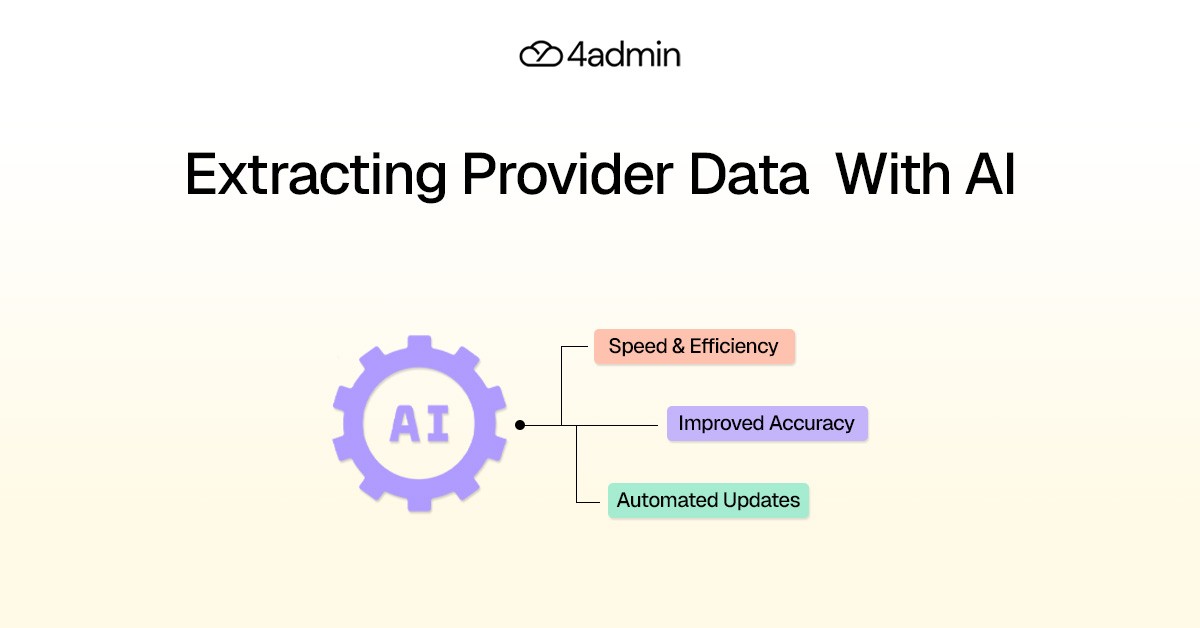
Provider documents sit at the centre of an advice firm’s transfer business process. Policy information, valuations, application packs, letters of authority, benefit statements. They arrive daily and in volume.
Most firms still rely on people to read these documents, interpret them, and manually key provider data into CRMs and workflows. That approach works at low volume, but it quickly becomes costly as the firm grows.
This article explains how AI extracts data from provider documents, step by step. Not as theory, but as a practical workflow automation process designed for real-world inconsistency.
The Reality of Provider Documents in Advice Firms
Provider documents never arrive perfectly ready for automation.
They arrive as PDFs, scanned images, emails with attachments, and multi-page forms. Some are digitally generated. Others are scanned copies with poor image quality. Many are semi-structured documents, meaning they follow a loose format but vary significantly between providers and even between versions from the same provider.
In such a scenario, common challenges in extracting provider data include:
Unstructured data buried in long PDFs.
Tables that shift position between documents.
Inconsistent labels for the same fields.
Mixed text, images, and handwritten inputs.
As document volumes increase, manual handling becomes a bottleneck. Admin teams spend more time reading, re-keying, checking, and correcting unstructured data. Errors creep in, turnaround times slow down, and data quality suffers.
This is the problem provider document automation is designed to solve.
How Data Is Extracted in Practice
AI-based extraction is not a single action or tool. Rather, it’s a workflow made up of several stages, each handling a specific part of the problem.
At its core, this process combines artificial intelligence, OCR (optical character recognition), machine learning extraction, and data validation to turn messy documents into structured data outputs systems can actually use.
Below is a clear breakdown of how AI extracts data from provider documents, step by step:
Intelligent Document Processing (IDP): The End-to-End Approach
Intelligent Document Processing, or IDP, describes the full workflow that turns provider documents into usable data.
IDP handles variations through its AI information parsing, document classification, and structured data extraction system which operates without using fixed templates.
Here is a simple elaboration on how each step builds on the previous one:
Step 1: Document Ingestion and Pre-Processing
The process starts when documents arrive.
Documents may come through:
Email inboxes
Secure uploads
Provider portals
APIs or integrations
Before any extraction happens, documents go through pre-processing. This stage focuses on document parsing and data normalisation.
Typical actions include:
Image enhancement and noise removal.
Straightening the image and rotation correction.
Resolution adjustments.
Format normalisation across files.
This preparation step is critical. Following this step, clean, standardised inputs dramatically improve downstream OCR and extraction accuracy.
Step 2: Digital Transformation (OCR and ICR)
Once documents are prepared, they are converted into machine-readable text using OCR (optical character recognition).
Modern OCR and AI in document processing can handle:
Digitally generated PDFs.
Scanned documents.
Complex fonts and layouts.
Handwritten fields using ICR.
OCR quality directly impacts everything that follows. Poor text conversion leads to weak extraction, no matter how advanced the AI model is.
This is why OCR is treated as a foundational step,and not as an afterthought.
Step 3: Layout Analysis and Document Classification
After text conversion, AI looks beyond words and focuses on structure.
Document classification models analyse:
Page layouts
Tables, headers, and footers
Section boundaries
Repeating patterns
This allows the system to automatically identify document types, such as policy schedules, valuations, or LoAs, and apply the correct extraction logic.
This step is also where template variation handling becomes possible. When provider layouts change, AI adapts without requiring manual template rebuilds.
Step 4: Data Extraction and Context Understanding
With structure understood, the system finally moves into extraction.
Instead of relying on fixed coordinates, AI uses machine learning extraction and field recognition to identify relevant data points, including:
Names and reference numbers.
Dates and monetary amounts.
Policy details and plan types.
Contribution histories and fund holdings.
The context is key. The same number can mean different things depending on where it appears. AI uses surrounding text and layout cues together with document type information to achieve accurate meaning interpretation.
This approach also allows the system to to extract complex tables and line-item data from different document layouts to create structured data outputs that maintain consistency across multiple pages.
Hybrid Extraction: Why Rules and AI Work Together
Artificial intelligence alone is not enough. Neither are rigid rules.
The most reliable systems use a hybrid approach:
AI handles variability, ambiguity, and edge cases.
Deterministic rules enforce consistency and business logic.
While rules help with tasks like formatting, validation, and field mapping, AI information parsing handles the messy reality of provider documents.
When combined together, they deliver structured data extraction that works at scale.
Validation, Confidence Scoring, and Human-in-the-Loop
Accuracy and trust are non-negotiable in regulated advice processes.
Every extracted field goes through data validation checks and is assigned a confidence score. Confidence scoring happens at the field level, not just the document level.
When confidence drops below a defined threshold, exception flagging is triggered and the datapoint is highlighted for review.
This is where human review loops come in. Humans should only review what genuinely needs attention, rather than checking every document line by line. Corrections feed back into the system in turn, improves future accuracy.
This approach reduces risk without slowing down the overall data extraction process.
Continuous Learning and Adaptation
AI extraction systems come with continuous avenues for improvements and optimisation. Human corrections create feedback loops that allow machine learning extraction models to adapt to:
New provider formats.
Updated document layouts.
Changing terminology.
As patterns stabilise, accuracy increases and manual intervention drops. Over time, teams spend less time checking data and more time using it.
Integration Into Advice Firm Systems
Extraction only creates value when data flows into real systems.
Structured data outputs can be exported directly into:
CRMs.
Onboarding workflows.
LoA tracking processes.
Reporting tools.
This eliminates re-keying and duplicate entry, speeds up onboarding, and keeps provider data consistent across the firm.
This is where document workflow automation delivers measurable operational impact.
From Extraction to Execution: Where 4admin Fits
Using AI to extract data from provider documents is a foundation, but not the end goal.
If your extracted data is not fed directly into the back-office workflows of your advice firm, it is of less use.
4admin focuses on delivering extracted provider data directly to back-office workflows. The aim is not to replace your existing systems, but to enhance them by removing manual admin friction.
By combining provider document automation with workflow automation, firms can move from reading documents to executing tasks automatically.
Conclusion
AI document extraction isn’t a silver bullet. It’s a structured, repeatable process designed to handle inconsistency at scale.
Understanding how AI extracts data from provider documents means understanding more than OCR or models. Structure, validation, confidence scoring, and integration matter just as much.
For growing advice firms, the long-term impact is clear: Cleaner data, fewer operational bottlenecks, and a back office that scales without adding manual work.
FAQs
How Does AI Extract Data from Provider Documents?
AI systems use three technologies which include OCR, natural language processing, and pattern recognition to automatically detect and understand essential information found in unstructured provider documents.
What Types of Provider Documents Can AI Extract Data from?
AI can extract data from policy documents, statements, application forms, suitability reports, call transcripts, valuations, and provider correspondence.
How Accurate Is AI Document Data Extraction for Advice Firms?
AI extraction from financial documents can reach high accuracy of up to 99%. However, no AI is 100% accurate all of the time, so consideration for specific exceptions and edge cases is key.
Is AI Document Extraction Compliant with Consumer Duty Requirements?
Yes. AI document extraction when implemented with audit trails, validation of data, and human oversight goes a long way in complying with Consumer Duty requirements.
How Does AI Data Extraction Improve Back-office Efficiency in Advice Firms?
AI data extraction improves back-office efficiency by reducing manual data entry, speeding up processing, minimising errors, and allowing back-office teams to focus on higher-value client and compliance work.
Ready to automate your admin processes?
Learn how you can reduce admin backlog, ensure compliance, and increase capacity.