
When Letter of Authority (LoA) work starts piling up, hiring feels like the obvious fix. More admin people should mean faster processing, fewer delays, and better service.
But that is not how LoA bottlenecks usually work. In many advice firms, the real problem is not a lack of people. It is a weak process that breaks under pressure.
This is why back-office hiring often fails to solve LoA bottlenecks. It adds cost and complexity, but it does not remove the friction that slows the work down in the first place.
In this guide, we will look at why LoA processing delays happen, why extra headcount often does not fix them, and what firms should do instead.
Why Really Causes LoA Bottlenecks Happen
A Letter of Authority is rarely just one simple task. It involves collecting the right client data, using the correct format, sending it through the right channel, tracking the request, chasing providers, and handling the response properly.
That means the LoA process depends on accuracy, timing, and visibility. If one part goes wrong, the whole case can slow down.
In many firms, LoA work still runs through inboxes, spreadsheets, shared folders, and manual follow-ups. That setup may work at low volume, but it becomes fragile as case numbers grow.
This is where letter of authority bottlenecks begin. Cases get stuck between stages, updates are missed, and nobody has a clear view of what needs action next.
Why Hiring More Back-Office Staff Feels Like the Right Answer
When advisers are waiting on provider information, the pressure lands on operations teams. Managers see the backlog growing, hear complaints about turnaround time, and decide they need more hands.
That reaction is understandable. If the team looks overloaded, hiring seems like the fastest way to create more capacity.
The problem is that LoA bottlenecks are often caused by workflow design, not just workload size. If the process is messy, adding more people only spreads the mess across a bigger team.
So the backlog may still remain. It just becomes harder and more expensive to manage.
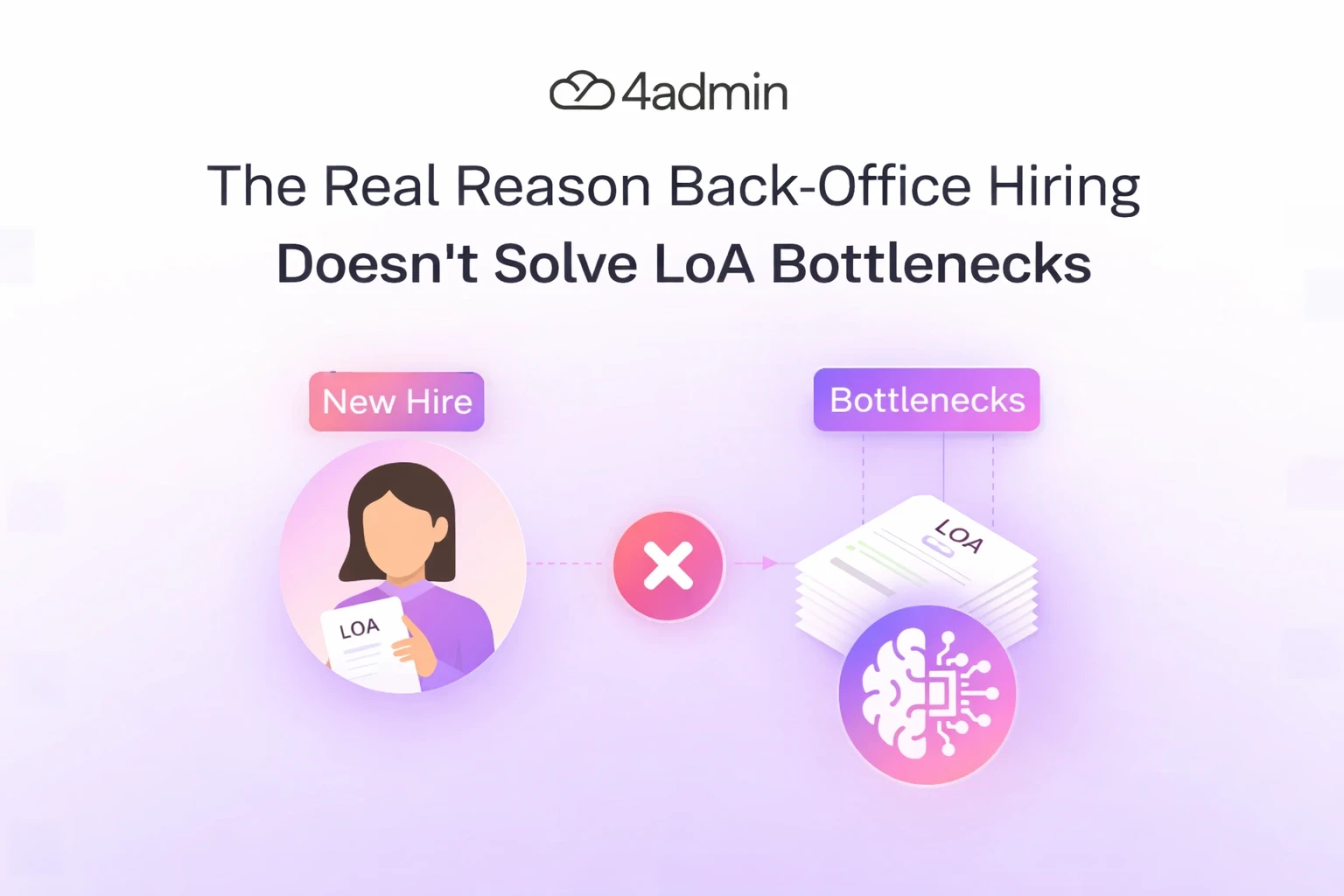
The Real Reason Back-Office Hiring Doesn’t Solve LoA Bottlenecks
The real issue is that hiring increases labour capacity, but it does not fix process friction. If the LoA workflow is slow, manual, and unclear, more people will still be working inside the same broken system.
That means the same delays continue. The team may still be chasing missing details, using outdated templates, re-keying information, and checking inboxes for updates.
In other words, back-office hiring does not remove the causes of LoA processing delays. It only adds more people to deal with the symptoms.
That is why many firms hire, yet still struggle with case backlog, inconsistent turnaround time, and poor workflow visibility. The root problem stays in place.
The Process Problems That Usually Cause LoA Delays
Most LoA bottlenecks come from a few repeat issues. These are operational problems, and they do not disappear by adding more staff.
Common causes include:
incomplete client or policy information at the start
manual data entry across multiple systems
inconsistent LoA templates or submission methods
no clear ownership at each workflow stage
weak follow-up routines with providers
poor visibility over outstanding requests
too many handoffs between team members
slow updates into CRM or back-office systems
rework caused by avoidable errors
Each of these problems creates friction. When several happen together, the whole replacement business process slows down. Related: Why Blaming Providers Won’t Fix Your LoA Delays
Why More Hiring Can Make the Problem Worse
More staff can help only when the process is already clear and controlled. If it is not, extra hiring can actually create new delays.
More people usually means more handoffs. One person gathers data, another sends the LoA, another chases it, and someone else updates the case.
Every handoff creates room for delay, confusion, or duplication. Work gets touched more often, but it does not always move faster.
There is also the issue of training. New team members need time to learn provider rules, internal steps, and document standards.
During that period, experienced staff often spend more time checking work and answering questions. So the team gets busier before it gets better.
This is why back-office inefficiency can grow even after recruitment. The firm adds headcount, but the process remains hard to control.
Related Resources: How to Scale Your Financial Advice Firm Without Hiring More Staff
The Part Firms Often Miss: LoA Work is a Flow Problem
LoA work is not only about how many people are available. It is about how smoothly work moves from one stage to the next.
If cases sit idle in inboxes, wait for missing information, or depend on memory-based follow-ups, the problem is flow. The bottleneck is in movement, not just manpower.
That is why some firms with smaller teams perform better than larger ones. Their workflows are tighter, clearer, and easier to track.
A firm can have enough staff and still have poor operational efficiency. If the work does not move cleanly, the queue keeps growing.
Where the LoA Process Usually Breaks Down
Most firms do not have one single failure point. The slowdown usually appears across several steps.
The LoA process often breaks down in these areas:
client details are collected late or entered inconsistently
provider-specific requirements are missed
submissions are sent through the wrong route
follow-up dates are not scheduled properly
provider responses are received but not processed quickly
case status is not updated in real time
advisers have no clear view of progress
Once that happens, the case becomes harder to manage. Teams spend more time finding information than moving the work forward.
That is how LoA bottlenecks build up quietly. The delay is not always one big problem. It is often a chain of smaller operational gaps.
Signs the Problem is Not Staffing
Some firms assume the team is under-resourced when the real issue is workflow control. There are clear signs that point to process, not just headcount.
Watch for patterns like these:
cases age differently depending on who handles them
nobody can see exact status without asking around
follow-ups rely on memory or personal reminders
the team uses spreadsheets to track progress
the backlog stays high even after hiring
managers struggle to report on turnaround times
cases stall when one person is absent
the same information is entered more than once
If these issues sound familiar, the business likely has a process bottleneck. Hiring alone will not solve that.
Why This Matters for Growth and Profitability
LoA delays do more than frustrate the admin team. They slow down the whole advice process.
When provider data is delayed, replacement business slows down. Reviews take longer, transfers take longer, and revenue gets pushed further out.
There is also a cost issue. More staff increases salary cost, management time, software access, and onboarding effort.
If the process still underperforms, the cost per case goes up. That puts pressure on margins without delivering better output.
This is why firms need to link LoA bottlenecks to business performance. It is not just an admin issue. It is a growth issue.
What Actually Improves LoA Turnaround Time
If hiring is not the answer on its own, what works better? The strongest improvements usually come from fixing the workflow before expanding the team.
Firms should focus on:
standardising the LoA process from start to finish
setting clear ownership for each stage
reducing manual re-keying
building consistent follow-up rules
tracking case status centrally
using dashboard reporting for visibility
spotting stalled cases early
improving provider-specific submission accuracy
automating repetitive admin steps where possible
These changes reduce friction inside the process. They help the same team complete more work with better consistency.
That is how firms improve back-office efficiency metrics in a meaningful way. They make the workflow easier to run, easier to monitor, and easier to scale. Learn more: How to Reduce LoA Processing Time?
The Role of Process Automation in LoA Work
Process automation does not remove human oversight. It removes repetitive admin steps that waste time and increase error risk.
For example, automation can help with task routing, reminders, status updates, document handling, and structured case tracking. That gives teams more control over the workflow.
This matters because many letter of authority bottlenecks are caused by routine tasks being handled manually. When those tasks are automated, staff can focus on exceptions and higher-value work instead.
That creates real operational capacity. It is usually far more effective than adding headcount into an already inefficient system.
When Hiring Does Help
Hiring is not always the wrong move. It can help when the process is already structured and the team genuinely lacks capacity.
In that situation, extra staff can increase throughput because the workflow is already clear. New people can step into defined tasks without creating confusion.
But that only works when the basics are already in place. If the LoA process is inconsistent, hiring should come after process improvement, not before it.
So the better question is not, “Do we need more people?” It is, “Have we fixed the workflow enough for more people to help?”
What Advice Firms Should Do Next
If your firm is struggling with LoA processing delays, start by diagnosing the workflow. Look at where cases wait, where rework happens, and where visibility is weak.
Then review the basics:
Is the process standardised?
Is ownership clear?
Are follow-ups planned properly?
Can managers see the live backlog?
Are provider rules easy to access?
Is case data updated in one central place?
If the answer is no to several of these, the bottleneck is likely operational. That is where the real improvement work should begin.
How 4admin Helps Solve LoA Bottlenecks Without More Hiring
When LoA bottlenecks keep growing, the issue is often not a lack of people. It is usually a lack of structure, visibility, and control across the workflow.
That is where 4admin helps. Instead of asking firms to keep adding headcount, 4admin helps remove the manual steps and process gaps that slow LoA work down.
4admin supports advice firms by helping them:
Centralise LoA submission and tracking
Automate provider follow-ups
Reduce manual re-keying
Extract structured data from provider documents
Flag missing information earlier
Improve visibility across the whole LoA process
Generate cleaner CRM-ready outputs
This matters because many LoA delays happen between steps, not just within them. When the workflow is clearer and repetitive admin work is reduced, firms can handle more volume without creating the same back-office bottlenecks again.
Want to modernize your internal operations? 4admin Back Office Automation gives your business a smarter way to manage back-office tasks. Book a consultation with the 4admin team.
Final Thoughts
The real reason back-office hiring doesn’t solve LoA bottlenecks is simple. Hiring adds people, but it does not fix broken flow.
If the process has too many handoffs, too much manual work, and too little visibility, the backlog will keep coming back. The firm just ends up carrying a bigger cost base around the same problem.
The firms that improve LoA turnaround time do not rely on headcount alone. They build a cleaner process, create better visibility, and use automation where it removes friction.
That is what turns LoA work from a recurring bottleneck into a scalable part of the business.
Frequently Asked Questions
Why doesn’t hiring more admin staff fix LoA bottlenecks?
Because most LoA bottlenecks are caused by workflow problems, not just lack of capacity. If the process is manual, unclear, or poorly tracked, more staff will still be working inside the same inefficient system.
What causes LoA processing delays in advice firms?
Common causes include incomplete information, manual data entry, inconsistent submission methods, weak follow-up routines, poor workflow visibility, and too many handoffs between staff.
Can hiring ever help with Letter of Authority work?
Yes, but only when the LoA process is already structured and controlled. If the workflow is broken, hiring should not be the first fix.
How can firms improve LoA turnaround time?
They can improve turnaround time by standardising the process, reducing manual tasks, assigning clear ownership, tracking cases centrally, and using automation to handle repetitive admin steps.
Is this only a staffing issue?
No. In many firms, LoA bottlenecks are really a process design issue. Staffing matters, but it only helps when the workflow is already built to scale.
Ready to automate your admin processes?
Learn how you can reduce admin backlog, ensure compliance, and increase capacity.