
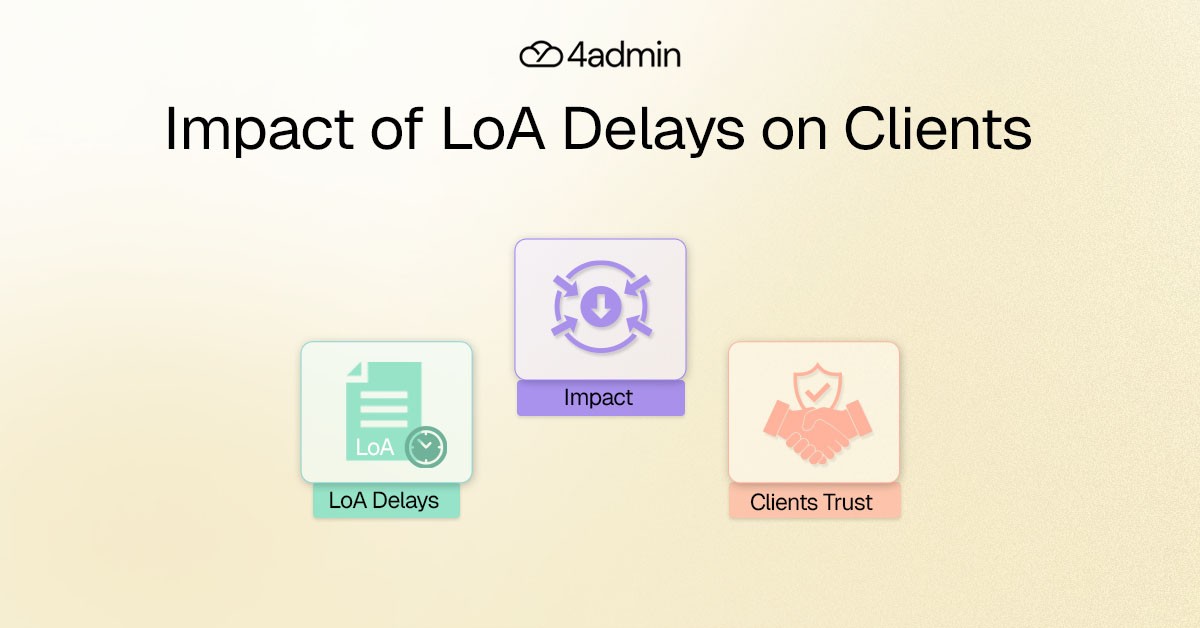
In a financial advice firm, the quality of your service delivery matters just as much as your advice. From your clients’ point of view, everything blends into one holistic experience. When letters of authority are delayed, your clients don’t see an operational issue happening behind the scenes, instead, they experience it as slow service, poor responsiveness, or a lack of follow-through.
This gap between how advice firms view LoAs internally and how clients experience them externally is where trust quietly starts to erode. The impact of LoA delays is never visible in one moment. It builds gradually through missed expectations and growing uncertainty.
Understanding the ways LoA delays impact client trust is essential for any firm focused on long-term client relationships. This blog helps you understand what they are, discover the key impacts of LoA delays, and offers strategies to mitigate the impact.
What an LoA Delay Feels Like to a Client
Inside a firm, letters of authority are an administrative step. For clients, they’re a signal that things are moving.
Once a client signs an LoA, they expect momentum. They believe analysis, reviews, and provider conversations are underway. When a turnaround time stretches without visibility, the experience shifts quickly.
From the client’s perspective:
Updates feel vague, repetitive, or non-committal.
Progress is difficult to see or understand.
Advice or transfers are held back with no clear reason.
Confidence starts to drop before advice is even delivered.
The entire waiting process feels like inaction. And in financial advice, inaction often feels risky. This is where client confidence erosion begins, even if the advice later would be effective.
Key Impacts of LoA Delays on Client Trust
1. Delayed Onboarding and Advice
Letters of authority are the starting point for onboarding momentum. When they are delayed, onboarding slows down immediately.
When information gathering, provider communications, and advice meetings are pushed back, the clients can stay stuck in unsuitable products. This early delay makes the very start of the relationship uncertain. Even before advice is delivered, expectation management becomes shaky.
A slow onboarding experience sets a fragile foundation, where clients start questioning reliability long before outcomes are discussed.
2. Missed Expectations and Growing Frustration
Clients expect progress once a letter of authority is signed. Delays tend to disrupt that expectation immediately.
When service delivery delays occur without clarity or prompt explanation, frustration builds. Waiting without an explanation can feel like being ignored. From the client’s side, internal bottlenecks do not matter. What they only see is the absence of movement and the lack of responsiveness.
Over time, this frustration turns into doubt, that turns the overall advice experience murky.
3. Perception of Inefficiency and Unreliability
Letter of authority delays often indicate inefficiency to clients, even if that is not the reality internally.
Missed timelines suggest a lack of control. Clients start to question whether their case is a priority or whether the firm is capable of managing their affairs. When processing times and trust fall out of sync, reliability becomes questionable.
Repeated delays reinforce this perception and weaken confidence in future service delivery.
4. Erosion of Confidence in Competence
Every LoA delay hampers the image of the firm’s perceived competence.
Clients may not understand the mechanics of letters of authority, but they do associate a slow turnaround time with operational inefficiency. If something as foundational as information access moves slowly, clients may wonder how well other details are being handled.
Even when advice quality remains high, emotional confidence declines. Adviser-client relationship erosion often starts from here, quietly and unintentionally.
5. Strained Client Relationships and Communication Breakdowns
When delays persist, communication becomes reactive.
Updates arrive only after follow-ups, explanations become defensive or vague. Blame-shifting to providers can damage credibility, even when it is partially true. Clients feel excluded from the entire progress and uncertain about the next steps.
These client communication gaps make collaboration harder and introduce tension into what needs to be a trusted relationship.
6. Anxiety, Financial Impact, and Escalation
Operational delays can only create uncertainty.
With advice timelines slipping, reviews being postponed, and transfers on hold, clients are left unsure about outcomes that may affect their financial decisions.
As waiting continues, anxiety only increases. Each follow-up adds to the already built-up frustration. What began as a simple delay becomes an emotional strain, which directly affects client satisfaction and trust.
7. Reputational Damage and Negative Word-of-Mouth
Dissatisfied clients typically talk about delays more than outcomes.
Reviews and referrals tend to focus on service speed, responsiveness, and communication. The root cause of LoA delays rarely matters to the person sharing their experience. Reputational risk grows even when advice results are strong.
Hence, your slow service becomes the headline, and not the value delivered.
8. Increased Client Churn and Lost Loyalty
The loss of trust shows up before your client or prospect finally chooses to disengage.
Clients who experience repeated letter of authority delays are less likely to return for future advice. They become more open to alternatives that promise faster, clearer service. Thus, loyalty erodes quietly, long before a switch ever happens.
The long-term impact of LoA delays often appears as lost relationships, not just as operational inefficiency.
Where LoA Delays Usually Come From
LoA delays are common across advice firms, not because teams lack effort, but because the process itself is fragmented.
Typical causes include:
Letters of authority handled across multiple inboxes and systems.
No single owner is responsible end-to-end.
Heavy manual checking, re-keying, and validation.
Limited visibility for operations, advisers and clients.
Providers blamed while internal structure remains unchanged.
In most cases, the problem is not people. It is the way the workflow is designed. Related Recourse: Why Blaming Providers Won’t Fix Your LoA Delays
Mitigating Damage When LoA Delays Happen
While clear communication matters, communication alone cannot solve systemic delays.
Transparency helps set expectations, but it does not remove operational drag. Ownership improves accountability, but manual processes still slow progress. Even well-meaning teams struggle when letters of authority are handled across disconnected tools and teams.
To mitigate impact of LoA delays, firms should focus on the following:
Transparency and communication
Inform your clients early when delays occur, not after they follow up. Set clear explanations, realistic timelines, and provide regular updates to help manage expectations and reduce uncertainty.
Even when progress is slow, transparency reassures clients that their case is being actively managed and given priority.
Process improvement
Trust issues often reflect underlying process issues. Identifying where letters of authority are stuck and removing the manual bottlenecks improves turnaround time and thus perceived reliability.
Structure your workflows and integrate supporting tools to reduce friction and make progress more predictable for both advisers and clients. For a deeper breakdown, read How to Reduce LoA Processing Time?
Clear accountability
LoAs need clear ownership from the start. Practice a clear accountability setting where responsibility is defined, follow-ups are timely and handovers are standardised.
Consistent handling strengthens service delivery and reinforces prospect’s confidence in the firm’s ability to manage their affairs reliably and confidently.
When delays remain part of the system, trust issues persist. Fixing perception without fixing processes has clear limits.
Removing the Root Cause of LoA Delays with 4admin
Most LoA delays are not about effort or capability. They come from the way the work is set up.
4admin helps firms fix that structure. By giving LoAs clear ownership, there is less back and forth, less chasing, and fewer things falling through the cracks. Automated intake and processing take the manual grind out of the workflow, while shared visibility means support teams, advisers and clients can actually see progress as it happens.
When the process runs cleanly, delays stop being a constant distraction and trust has the space to be built.
By reducing delays at the source, firms do more than just improve efficiency, they protect client trust where it matters most.
Conclusion
Clients judge reliability by what happens after they sign. When letters of authority move slowly, trust erodes quietly. When they move predictably, confidence grows - without needing explanation after re-explanation.
When turnaround times become predictable, service responsiveness improves naturally. Advisers spend less time managing delays and more time delivering advice. Clients regain confidence as the progress remains visible and consistent.
Firms that invest in fixing the LoA workflow are not just improving operations. They are strengthening brand perception, protecting relationships, and delivering an advice experience where clients feel confident from start to finish.
FAQs
How to Handle Client Delays?
Handle client delays by setting clear expectations upfront, providing regular status updates, and proactively explaining any bottlenecks before clients have to ask.
Why Do Letter of Authority Delays Frustrate Clients so much?
LoA delays frustrate clients because they stall visible progress, create uncertainty, and make clients feel their financial matters are not being actively managed.
How Do LoA Delays Affect Client Trust in Financial Advice Firms?
Repeated LoA delays erode client trust by signaling inefficiency, poor communication, or lack of control over vital administrative processes.
Are LoA Delays a Provider Issue or an Internal Process Issue?
LoA delays are usually a mix of provider response times and internal process inefficiencies, with the latter often being more within a firm’s control.
Can Slow LoA Processing Lead to Client Churn?
Yes, slow LoA processing can directly lead to client churn, and lower prospect conversions, as they perceive administrative delays as low service quality.
How Can Financial Advice Firms Reduce LoA Delays without Hiring More Staff?
Firms can reduce LoA delays by standardising workflows, automating follow-ups, and using centralised systems to manage LoAs end-to-end. Related Recourse: How to Scale Your Financial Advice Firm Without Hiring More Staff
Ready to automate your admin processes?
Learn how you can reduce admin backlog, ensure compliance, and increase capacity.