
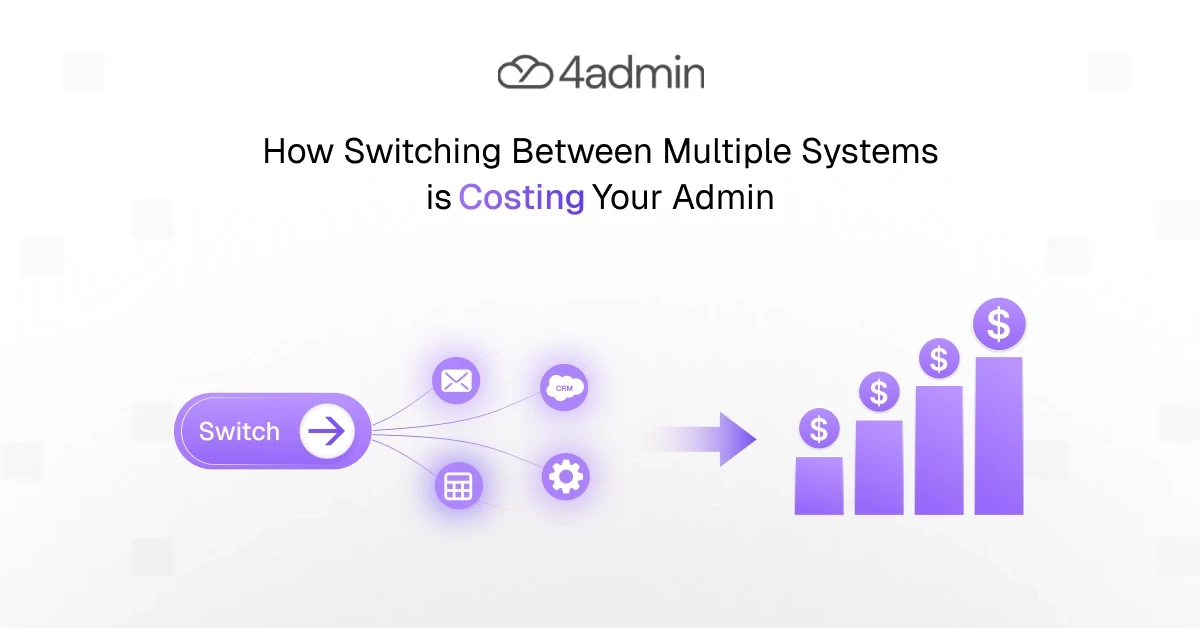
Financial advice firms don't struggle because of one bad system. The bigger issue is the operational friction created between all the systems they are using.
Most firms rely on CRMs, portals, spreadsheets, document storage tools, and email to manage daily workflows. While each system solves a specific problem, constant system switching creates hidden admin costs that are often overlooked.
Teams spend valuable time re-entering data, searching for documents, reconciling information, and managing fragmented workflows across disconnected tools.
Over time, these manual processes lead to workflow disruption, duplicate data entry, process delays, operational inefficiency, and rising admin workload. Many firms accept this as normal operational complexity, however it shouldn't be the case.
This blog will help you identify the hidden admin cost of switching between multiple systems and understand how firms can reduce unnecessary operational friction.
What Does “Hidden Admin Cost” Means in a Financial Advice Firm?
Hidden admin cost refers to the operational time, effort, and resource drain created by fragmented systems and disconnected workflows. These costs often do not appear directly on financial reports, but they affect productivity, turnaround times, staff efficiency, and scalability across the business.
In financial advice firms, this usually happens when employees constantly move between different tools to complete a single task.
A provider pack may arrive through email, information might then be reviewed manually, entered into a spreadsheet, transferred into a CRM and checked against compliance requirements.
Each additional step increases:
manual processes
user friction
duplicate data entry
integration gaps
process delays
operational inefficiency
While each individual task may only take a few minutes, repeated system switching across hundreds of client cases creates a substantial admin burden over time.
Common Examples of Hidden Admin Costs in Financial Advice Firms
Many firms experience hidden admin costs without immediately recognising them as operational problems. Common examples may include:
Re-entering client or provider data into multiple systems.
Searching through emails for missing provider information.
Switching between provider portals during onboarding or transfers.
Reconciling inconsistent client records across systems.
Updating CRMs manually after provider responses.
Internal handovers requiring staff to repeat or verify information.
Compliance reviews slowed by incomplete audit trails.
These workflow inefficiencies often become normalised inside growing firms, even though they reduce overall operational capacity.
5 Core Admin Costs of Switching Between Multiple Systems in Financial Advice Firms
1. The "Context Switching" Productivity Tax
One of the biggest hidden admin costs is the productivity loss caused by constant context switching.
Lost Time
Every time a team member switches between systems, there is a small but repeated time loss. Logging into different platforms, searching for information, downloading documents, uploading files, or navigating different interfaces all interrupt workflow continuity.
In financial advice firms, employees may move between:
CRM systems
provider portals
spreadsheets
document storage tools
communication systems
AI systems
Even minor interruptions repeated across dozens of daily tasks create substantial operational inefficiency over time.
Cognitive Load
System switching also increases cognitive load. Staff must remember different workflows, interfaces, login requirements, naming conventions, and data locations across multiple tools.
This fragmented working environment makes it harder to maintain focus and increases the likelihood of:
missed information
inconsistent records
manual errors
slower task completion
As workflows become more fragmented, employees spend more mental energy managing systems rather than completing meaningful operational work.
Mental Fatigue
Constant workflow disruption creates mental fatigue across operations teams. Employees dealing with repetitive administrative tasks and disconnected systems often experience frustration and reduced productivity.
This becomes particularly problematic in high-volume firms where paraplanners and administrators manage large numbers of provider interactions and client cases simultaneously.
Over time, excessive system switching contributes to:
reduced operational efficiency
slower turnaround times
lower employee satisfaction
increased burnout risk
2. Operational Inefficiencies and Redundancy
Disconnected systems frequently create duplicate work across the business.
Duplicate Data Entry
Duplicate data entry remains one of the most common operational inefficiencies in financial advice firms.
Teams often manually enter the same information into:
CRMs
provider portals
back-office systems
compliance records
spreadsheets
Manual data entry tends to have an error rate of roughly 1 to 4%. This increases admin workload as well as raises the likelihood of inconsistencies between systems.
Manual processes like these consume valuable operational time that could otherwise be spent on client servicing or revenue-generating activities.
Information Silos
Fragmented systems often create data silos where important information becomes isolated within specific platforms or departments.
For example:
provider communications may sit inside email inboxes,
compliance notes may exist in separate systems,
valuation data may remain trapped inside provider portals,
operational updates may live in spreadsheets.
As a result, staff spend additional time locating, verifying, and reconciling information across disconnected tools.
Information silos also reduce visibility across teams, making collaboration slower and less efficient.
Slowed Decision-Making
When information is scattered across multiple systems, decision-making becomes slower.
Managers and operational teams may struggle to access:
complete client records
workflow status updates
provider communication history
compliance documentation
This lack of centralised visibility creates delays throughout operational workflows and increases process bottlenecks across the business.
3. Financial and Resource Drain
The hidden admin cost of fragmented systems extends beyond just productivity loss and directly impacts operational costs.
Higher IT Overhead
Managing multiple systems also increases IT complexity.
Internal teams or external consultants will need to handle:
software maintenance
integrations
user access management
troubleshooting
updates
cybersecurity oversight
As the number of systems grows, so does the operational burden required to maintain them.
Integration gaps between platforms often create additional technical challenges that consume both time and resources.
Training and Support Costs
Each additional system introduces more onboarding and training requirements.
New employees need to learn:
multiple interfaces
different workflows
varying operational processes
system-specific procedures
This increases training costs and slows employee ramp-up time.
Ongoing support requirements also become more difficult when teams rely on fragmented systems with inconsistent workflows.
Staff Turnover
Operational complexity caused by fragmented systems can contribute to employee dissatisfaction and staff turnover.
Teams working within inefficient workflows often experience:
repetitive admin burden
operational frustration
excessive manual work
reduced productivity
Replacing experienced operational staff creates additional disruption, training costs, and workflow delays.
4.Technical and Strategic Costs
Fragmented systems create long-term technical and operational limitations that can slow business growth.
Integration Bottlenecks
Many financial advice firms rely on partial integrations between systems. However, these integrations are often limited, outdated, or dependent on manual intervention.
As workflows evolve, firms encounter:
broken integrations
inconsistent data syncing
workflow disruption
incomplete automation
vendor dependency
These integration bottlenecks prevent firms from building scalable operational processes.
Data reconciliation
When multiple systems contain overlapping information, staff frequently need to reconcile data manually. Repetitive tasks like scheduling and reconciling reports end up consuming an average of 2 hours or more for 41% of advisers.
For example:
client records may differ across platforms,
provider updates may not sync correctly,
workflow statuses may become inconsistent,
financial data may require manual verification.
Data reconciliation adds significant administrative overhead and increases operational risk.
Integration and maintenance tax
Over time, firms effectively pay an ongoing “integration and maintenance tax” to keep disconnected systems functioning together.
This includes:
maintaining APIs
troubleshooting sync issues
updating workflows
monitoring system compatibility
adjusting operational processes
These hidden operational costs often increase as firms scale and adopt additional tools.
5. Increased Compliance Gaps and Security Vulnerabilities
System fragmentation also creates compliance and security challenges.
Compliance Gaps
When workflows are spread across multiple systems, maintaining consistent compliance oversight becomes more difficult.
Important information may be:
stored in separate platforms
updated inconsistently
missing from audit trails
difficult to verify
This increases compliance risk, particularly in regulated environments of financial advice firms where documentation and operational transparency are critical.
Security Vulnerabilities
Using multiple disconnected systems increases the number of potential security exposure points across the organisation.
Firms may face:
inconsistent access controls
unmanaged user permissions
varying security standards
increased data handling risks
As employees move information manually between systems, the risk of human error and data exposure also increases.
The Impact of Hidden Admin Cost of Switching Between Multiple Systems for Financial Advice Firms
Over time, the hidden admin cost of system switching affects nearly every part of a financial advice firm’s operations.
Common business impacts include:
reduced operational capacity
slower onboarding and transfer processing
increased admin workload
delayed client servicing
higher operational costs
reduced scalability
workflow bottlenecks
lower employee productivity
inconsistent client experiences
Many firms assume growth challenges are caused by staffing limitations, when in reality operational inefficiency and fragmented systems are slowing workflows behind the scenes.
How to Identify the Hidden Admin Cost in Your Firm?
Firms can identify hidden admin costs by examining where operational friction appears repeatedly within workflows.
Warning signs often include:
staff switching between systems throughout a single task
repeated duplicate data entry
manual reconciliation work
inconsistent client records
delayed onboarding processes
excessive spreadsheet usage
disconnected audit trails
repeated provider follow-ups
operational bottlenecks between teams
Workflow mapping exercises can help firms identify where time loss and workflow disruption occur most frequently.
How 4admin Helps Firms Reduce System Switching Without Replacing Everything
Many firms assume reducing operational inefficiency requires replacing their entire technology stack. In reality, the bigger problem is often the fragmented workflow between systems.
4admin helps financial advice firms reduce system switching by centralising operational workflows around provider communication, document processing, and structured data handling.
Instead of forcing teams to move manually between disconnected tools, 4admin helps streamline:
LoA workflow
provider pack processing
data extraction
workflow visibility
operational tracking
CRM updates
provider communication management
This reduces:
duplicate data entry
admin workload
workflow disruption
integration gaps
operational inefficiency
Importantly, firms can improve workflow efficiency without replacing their existing CRM or core operational systems.
The Real Cost Is the Work Between Systems
The hidden admin cost of switching between multiple systems is rarely caused by a single platform. The real issue comes from fragmented workflows, disconnected processes, and the operational effort required to keep systems aligned.
For financial advice firms, these hidden costs appear through duplicate data entry, process delays, integration gaps, workflow disruption, and rising admin workload. While each inefficiency may seem small individually, together they create substantial operational drag across the business.
Firms that improve operational efficiency are not necessarily using fewer systems. They are reducing the friction between systems, minimising manual processes, and creating more connected workflows that allow teams to work faster, more accurately, and with greater operational visibility.
If you're out on the hunt to reduce the admin cost of switching between systems without overhauling your existing tech stack, book a demo to see how 4admin does it for you.
FAQs
When should a business consolidate its software stack?
Look for signs like overlapping features or data reconciliation bottlenecks. Growth phases often expose scalability limits.
How to calculate the admin cost of my current systems?
Track time on switches, errors, and redundancies via audits or tools. Compare against benchmarks.
What metrics show multiple systems are costing too much?
Monitor data entry hours, error rates, and tool underutilisation. Aim for KPIs like reduced task completion time post-consolidation.
What is the true cost of poor system integration?
Poor system integration results in duplicate efforts and outdated info, raising operational overhead. For mid-sized firms, this can mean $400K+ in annual waste.
What features make a unified system admin-cost effective?
Native integrations and single sign-on cut switching friction. Automation reduces redundancies for scalable operations.
What causes SaaS sprawl in businesses using multiple tools?
Shadow IT and departmental purchases lead to redundant licences and underused features. This fragments budgets, with firms often paying for 7-12 overlapping apps.
Ready to automate your admin processes?
Learn how you can reduce admin backlog, ensure compliance, and increase capacity.