
Most advice firms can tell whether a transfer case is open, delayed, or complete.
The harder question is whether they can prove what happened across the full transfer journey.
When compliance teams run file checks, a client complaint comes in, an adviser asks why a case has stalled, or an operations director wants better management information, a basic status update is not enough.
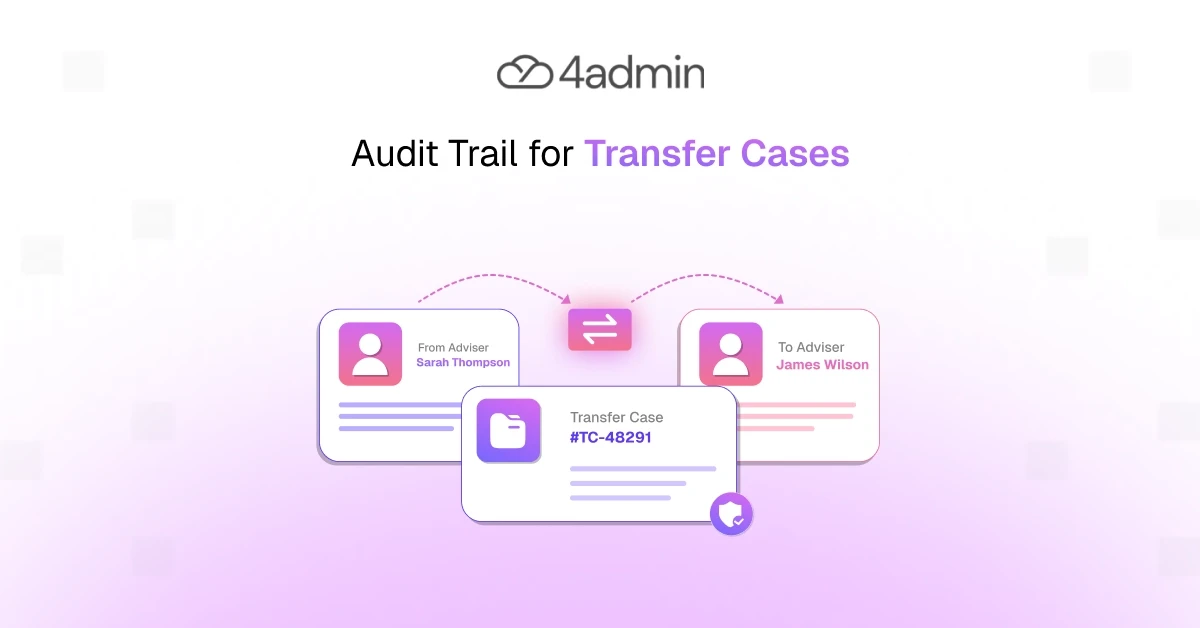
The firm needs an audit trail for transfer cases that shows who acted, what happened, when it happened, what changed, what was received, what was missing, and where the information came from.
For many firms, that evidence trail is harder to find than it should be.
This blog helps you understand what an audit trail for transfer cases looks like and why your firm needs one to prove what happened to a transfer case.
Transfer Case Tracking is Not the Same As Control
Transfer case tracking helps a firm see where a case is now. That matters, but it is not the same as control.
A case marked as “in progress” does not show whether the Letter of Authority was accepted first time. A case marked as “provider pack received” does not prove that the transfer documentation was complete.
A CRM note saying “updated” does not show which figures were taken from the provider pack, who checked them, or where those figures came from.
That is the gap between case tracking and a proper transfer case audit trail.
Transfer case visibility should not only show the current status. It should show the full case history behind that status. Without that, the firm may know that a case moved forward, but not be able to evidence how or why.
The real test is not whether the case eventually completes. It is whether the firm can prove the transfer process from start to finish.
Where the Transfer Case Audit Trail Usually Breaks Down
Transfer administration often happens across too many places.
Email chains, spreadsheets, phone notes, provider portals, CRM notes, downloaded documents, manual task lists, third-party providers, and outsourced transfer services may all hold part of the case history.
One email may show that the LOA was submitted. A spreadsheet may show the latest transfer updates. A CRM note may show that the adviser was contacted. A provider pack may contain the values. A phone note may explain why the provider rejected the request.
But when the activity log is scattered across fragmented systems, no one has a single view of the transfer lifecycle.
This creates operational risk.
If the case is later reviewed, the firm may have to rebuild the transfer case history from memory, inbox searches, historical records, and disconnected audit records. That is slow, inconsistent, and hard to defend.
Why the Letter of Authority Stage is Only the Starting Point
Many firms treat transfer delays as an LoA problem. The Letter of Authority matters, but it is only one part of the transfer journey.
A strong LoA audit trail should connect the transfer request, signed authority, provider submission, provider response, chasing activity, returned documentation, missing information checks, and CRM update.
The key questions are simple:
Was the LoA signed correctly?
Was it sent to the right provider?
Was it accepted or rejected?
If rejected, why?
Was the provider chased?
What came back?
Was the provider pack complete?
Were the figures extracted correctly?
Was the CRM updated with advice-ready data?
These questions form part of the transfer process audit trail. If the firm cannot answer them clearly, the process may be moving, but the control is weak.
What Compliance Teams Need to See in a Transfer Case Audit
A transfer case audit is not only about proving that work was done. It is about showing that the work was handled properly.
For compliance checks, audit preparation, regulatory oversight, or a complaint investigation, compliance teams may need to see:
the original transfer request
the signed Letter of Authority or LOA
timestamps for key actions
provider acceptance or rejection
transfer updates and chasing activity
returned transfer documentation
missing information
source documents for key figures
client records and communications
who reviewed the case
what changed in the CRM
what action followed
This is process transparency in practice.
It also supports transfer process compliance because the firm can show not just the outcome, but the route taken to get there.
Where Transfer Admin Becomes Compliance Evidence
Some transfer cases need a deeper advice record, especially where pension transfer advice or safeguarded benefits are involved. That may include client objectives, risk profile, suitability evidence, scheme details, recommendation rationale, and specialist review where applicable.
That advice evidence matters.
But it does not replace the operational audit trail.
A suitability file may explain why advice was given. The transfer process audit trail shows how the case moved through the transfer operations workflow.
Both records matter, but they answer different questions.
The advice file supports the recommendation. The operational audit trail proves what happened across the transfer administration process.
Why Outsourced Transfer Services Create a Black Box
Outsourced LoA services can reduce internal workload and free-up capacity. They may support chasing, provider contact, processing, and case progression, and they may be right for some firms. But outsourcing does not remove the firm’s need for case ownership and accountability.
The problem starts when key actions, documents, timestamps, or updates sit outside the firm’s normal workflow. If the outsourced technology provider holds the detail, but the advice firm cannot see the full case history, the case can become a black box.
That creates a control issue for compliance teams and operations teams.The firm may know the case is moving, but it may not be able to prove exactly what happened, who acted, when it happened, or why a decision was made.
Control is not just about who completes the task. It is about whether the firm can evidence how the task was completed. Firms should consider automations which run on their own systems, so they can benefit from efficiency gains without sacrificing visibility.
What a Strong Transfer Case Audit Trail Should Include
A strong audit trail for transfer cases should give the firm a clear, chronological view of the transfer lifecycle.
It should capture the original transfer request, signed LoA, submission date, provider acceptance or rejection, provider chasing, transfer updates, provider responses, missing information, source documents, user activity, call transcripts, timestamps, status changes, CRM updates, review points, and final handover.
It should also make accountability clear.
That means the firm should be able to see who acted, what changed, when it changed, and what evidence supported the update.
This helps with audit findings, client complaints, regulatory compliance, record retention, and day-to-day process governance.
Why a Strong Audit Trail Matters for Consumer Duty and Client Outcomes
Transfer cases affect client outcomes.
When a transfer case stalls, the client waits. The adviser chases. The operations team searches for the latest update. Compliance may have limited workflow visibility. The firm may not know whether the delay sits with the provider, the client, the paperwork, the data, or the internal manual process.
Better transfer case visibility helps firms understand what is happening and where cases are getting stuck.
It also supports Consumer Duty evidence because the firm can show how the case was managed, what action was taken, where delays happened, and how the client journey was controlled.
This is not just an FCA or compliance issue. It is an operational control issue.
Also read: FCA Consumer Duty in 2026: What Compliance Looks Like for Advice Firms
How 4admin Supports Transfer Case Visibility and Control
4admin helps advice firms create clearer workflow visibility across LOA and transfer administration.
It supports LoA submission, transfer case tracking, provider-pack reading, missing-information checks, CRM-ready data extraction, and clearer case history - without taking process visibility outside of the firm’s remit.
The value is not only faster transfer administration. It is better control over the evidence trail.
Instead of relying on email chains, spreadsheets, manual updates, fragmented systems, and outsourced explanations, firms can build a clearer view of what happened across the transfer journey.
That gives compliance teams stronger audit records, operations teams better management information, and advisers more confidence that cases are progressing with proper process controls.
Better Audit Trails Can Improve More Than Just Compliance
A stronger audit trail for transfer cases also helps firms improve the process itself.
When the full case history is visible, operations teams can see where delays happen, which providers create the most friction, where LOAs are rejected, where missing information appears most often, and where workflow automation could reduce rework.
This turns the audit trail into useful management information.
It helps firms move from reactive chasing to stronger process governance. It also reduces operational risk because the firm can see patterns across transfer operations, not just individual case updates.
Conclusion
A completed transfer case is not always a controlled transfer case.
The real test is whether the firm can prove what happened, who acted, when it happened, where the information came from, and how the case moved from transfer request to advice-ready data.
Most firms do not have a transfer case audit trail problem because people are not working hard enough. They have one because the work is spread across fragmented systems, manual processes, email chains, spreadsheets, outsourced transfer services, and unclear ownership.
For advice firms, control is not just where the data sits.
Control is whether the firm can evidence the full history of the case.
Book a demo with 4admin to see how your firm can improve transfer case visibility, strengthen control, and keep a clearer audit trail across every LoA workflow.
FAQs
What records should a firm keep for transfer cases?
A firm should keep the transfer request, signed LOA, provider submissions and responses, chase notes, timestamps, source documents, and CRM change history so the full case journey is auditable.
How can I tell if my firm’s transfer audit trail is adequate?
You are likely to have an adequate transfer audit trail if you can answer who acted, what changed, when it changed, why it changed, and show the evidence behind each key update.
What questions should I ask a provider when assessing transfer admin controls?
Ask a provider how they capture timestamps, version control, evidence of actions, escalation points, document retention, and whether you can export the full case history into your own records.
How do lawfully signed LoAs need to be stored and evidenced?
Lawfully signed LOAs should be stored securely, linked to the related case, time-stamped, and retained with proof of receipt, acceptance, rejection, and any subsequent use in the transfer workflow.
Where can I read official FCA guidance on transfer case record-keeping?
For official FCA guidance, start with SYSC 9.1 on general record-keeping and the FCA Handbook record-keeping schedules relevant to your business area.
Can outsourcing transfer admin create compliance gaps?
Yes, outsourcing transfer admin can create compliance gaps if critical evidence sits outside the firm’s systems and the firm cannot reconstruct the full decision and action trail.
Ready to automate your admin processes?
Learn how you can reduce admin backlog, ensure compliance, and increase capacity.