
A letter of authority and a letter of authorization can look very similar.
Both documents give someone permission to do something on behalf of another person or business. Both are used to prove consent. Both can be requested by banks, providers, advisers, government bodies, service companies, or internal teams.
But they are not always used in the same way.
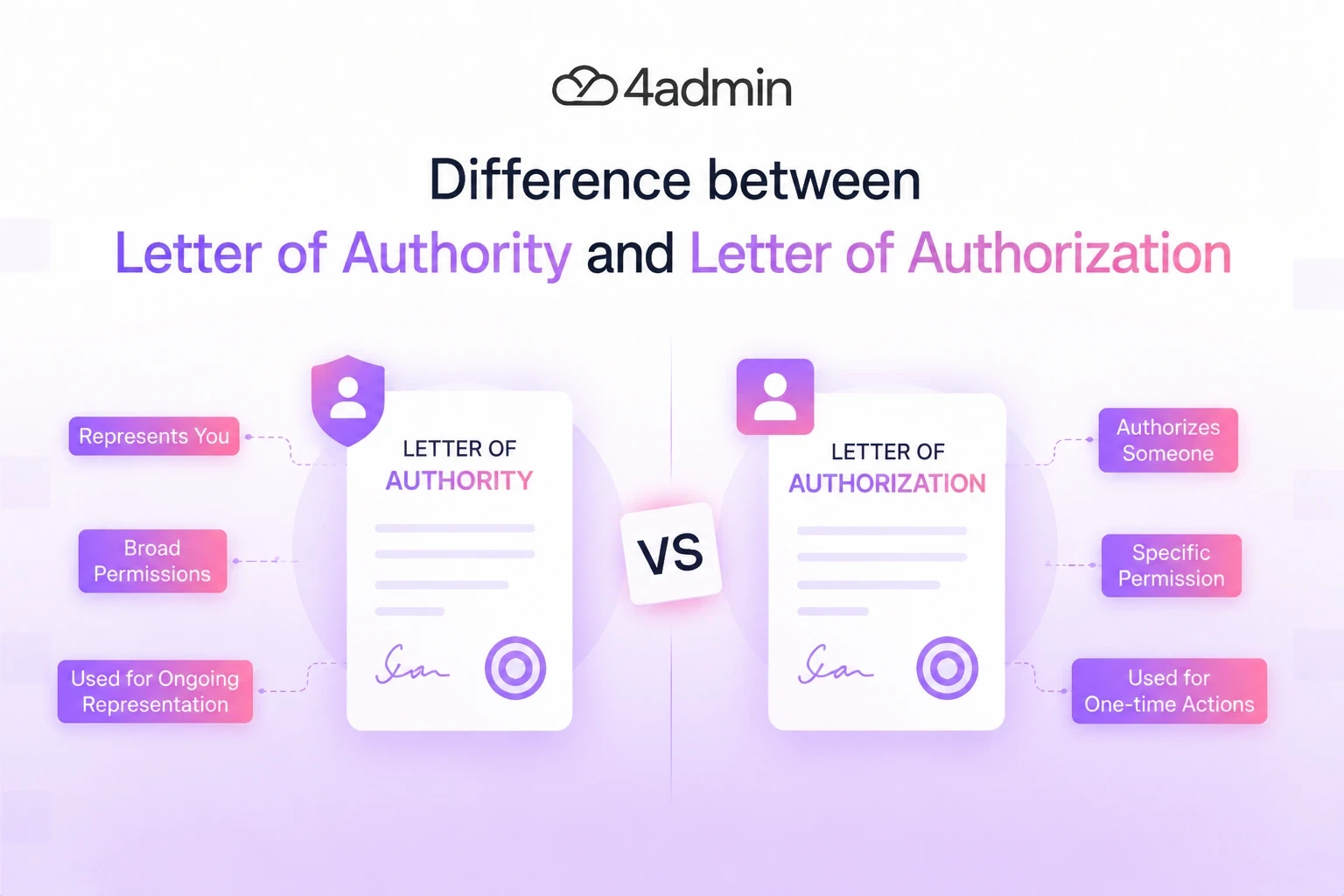
The main difference is that a letter of authority is often used to allow a third party to access information, communicate with providers, or act within a defined professional process. A letter of authorization is a broader term used for written permission to carry out a specific action.
In practice, the difference depends less on the title and more on what the document actually allows.
This blog explains the difference between a letter of authority and a letter of authorization, where each one is used, and why the wording matters.
What is a Letter of Authority?
A letter of authority is a written document that gives a person, firm, adviser, broker, or representative permission to act on behalf of someone else.
In financial advice, insurance, pensions, utilities, and professional services, a letter of authority is often used to let a third party contact providers and request information.
For example, a client may sign a letter of authority so their financial adviser can contact a pension provider and request:
policy details
valuations
charges
benefits
contribution history
transfer information
provider documents
The letter gives the provider proof that the client has given permission.
Without it, the provider may refuse to share information because of data protection, privacy, or internal compliance rules.
A letter of authority does not always mean the representative can make decisions or change the account. In many cases, it only allows information gathering.
That is why scope matters.
A well-written letter of authority should clearly explain who is giving permission, who is receiving authority, what information can be requested, what actions are allowed, and how long the authority lasts.
What is a Letter of Authorization?
A letter of authorization is also a written permission document.
But the term is broader.
It can be used in many different situations where one person allows another person to do something on their behalf.
For example, a letter of authorization may be used to:
collect documents
pick up a parcel
access an account
make a payment request
represent someone in a simple administrative task
approve a transaction
allow a child to travel with another adult
give temporary permission to an employee or family member
The document usually confirms that a specific person or organisation has permission to complete a specific action.
In other words, a letter of authorization is often more task-based.
It may not be tied to a regulated workflow or provider communication process. It may simply be a written record of consent for one defined action.
Letter of Authority vs Letter of Authorization: Quick Comparison
Area | Letter of Authority | Letter of Authorization |
Main Purpose | Gives a third-party authority to act or request information | Gives written permission to complete a specific action |
Common Use | Financial advice, pensions, insurance, utilities, professional services | General admin, banking, travel, school, business, personal tasks |
Scope | Can be narrow or broad depending on wording | Usually task-specific |
Third-party Role | Often used by advisers, brokers, representatives, or firms | Often used by individuals, employees, family members, or agents |
Provider Use | Commonly accepted by providers for information requests | May be accepted for one-off permissions or actions |
Compliance Importance | Often important in regulated workflows | Important, but usually depends on the situation |
Risk If Unclear | Provider rejection, delayed data access, compliance gaps | Wrong action, misuse of permission, unclear responsibility |
The Main Difference Between Letter of Authority vs Letter of Authorization
The main difference is how each document is usually used.
A letter of authority is often used to create an ongoing permission relationship between a client, a representative, and a provider.
A letter of authorization is usually used to give permission for a specific task or action.
For example, in a financial advice firm, a letter of authority may allow the adviser to contact multiple providers, gather policy data, chase missing information, and support the client review process.
A letter of authorization may simply allow someone to collect a document from an office or speak to a company about one issue.
So the difference is not just the wording.
The difference is the operational role of the document.
When a Letter of Authority is Used
A letter of authority is commonly used when a third party needs access to information from another organisation.
In financial advice firms, this is especially important.
Advisers and admin teams often need provider information before they can prepare advice, review pensions, analyse investments, or support transfer business.
A letter of authority helps the firm request that information in a controlled way.
It may be used for:
pension policy requests
investment account details
insurance policy information
provider pack collection
existing plan reviews
transfer value requests
annual review preparation
client onboarding
The provider uses the letter to confirm that the client has given permission.
This makes the LoA an important part of the back-office workflow.
If the letter is incomplete, outdated, unclear, or rejected by the provider, the case can slow down quickly.
When a Letter of Authorization is Used
A letter of authorization is more general.
It is often used when someone needs written permission to perform a specific action.
This could happen in personal, business, school, travel, banking, or administrative situations.
For example, a person may write a letter of authorization to allow another person to:
collect a certificate
receive documents
submit forms
speak to an organisation
pick up goods
access a record
complete a temporary task
approve a limited request
The key point is that the permission should be clear.
The letter should explain what the authorised person can do and what they cannot do.
If the wording is too broad, it can create risk. If it is too vague, the organisation receiving it may reject it.
Does the Name of the Letter Matter?
Sometimes, yes.
Some providers or institutions ask for a specific document type. They may require a “Letter of Authority” rather than a general “Letter of Authorization.”
Others may accept either term as long as the document includes the right information.
But the name alone is not enough.
A document called a letter of authority can still be rejected if it does not include the right client details, signatures, dates, provider information, or scope.
A document called a letter of authorization can still work if it clearly gives the required permission and meets the organisation’s rules.
The wording matters more than the title.
What Should Be Included in a Letter of Authority?
A strong letter of authority should be specific and easy to verify.
It should usually include:
client name and contact details
representative or firm name
provider or organisation name
clear scope of authority
information being requested
actions the representative can take
signature and date
expiry date or validity period
contact details
any required reference numbers
For financial advice firms, this detail matters because providers often have different rules.
Some may require wet signatures. Some may accept digital signatures. Some may want specific wording. Some may only accept a letter dated within a certain timeframe.
If these details are missed, the provider may delay or reject the request.
What Should Be Included in a Letter of Authorization?
A letter of authorization should also be clear and specific.
It should usually include:
name of the person giving permission
name of the authorised person
the exact action being permitted
the organisation involved
date of authorization
validity period
signature
contact details
identification details if required
The goal is to remove confusion.
The person receiving the letter should be able to understand who is authorised, what they are authorised to do, and how long the permission lasts.
Why This Difference Matters for Financial Advice Firms
For financial advice firms, the difference between these terms is not just a language issue. It affects workflow.
A letter of authority is often part of the client onboarding and provider data collection process. If it is not managed properly, the firm may face delays, missing information, repeated provider follow-ups, and incomplete case files.
This can affect:
client onboarding
provider communication
policy data collection
CRM updates
paraplanner handoffs
compliance records
audit trails
A letter of authorization may be useful for simple permissions, but it may not be enough for structured LoA processing unless it includes the right authority, scope, and provider-specific details.
This is why firms need to manage these documents carefully.
How 4admin Helps with LoA Workflows
4admin helps financial advice firms manage the operational work around Letters of Authority.
Instead of relying on manual tracking, scattered inboxes, and repeated provider chasing, firms can use 4admin to support a more structured LoA workflow.
This can help with:
LoA processing
Provider communication
Provider-pack review
Missing information checks
Case tracking
Data extraction
CRM and back-office updates
Audit trail visibility
The goal is not just to process documents faster. The goal is to reduce admin pressure, improve visibility, and help firms move cases forward with better control.
Bottom Line
A letter of authority and a letter of authorization both give permission, but their use is different.
A letter of authority is usually used in professional workflows where a third party needs to request information or deal with providers. A letter of authorization is broader and usually allows someone to complete a specific task.
The main difference is scope, wording, and purpose. For advice firms, clear LoAs help reduce provider rejections, avoid delays, and keep client cases moving smoothly.
Frequently Asked Questions
Is a letter of authority the same as a letter of authorization?
Not always. Both give permission, but a letter of authority is often used to let a third party act or request information within a professional process. A letter of authorization is usually a broader document used to permit a specific action.
Which one should financial advice firms use?
Financial advice firms usually use a Letter of Authority because providers often need formal client consent before sharing policy, pension, investment, or insurance information.
Can a letter of authorization be used instead of a letter of authority?
Sometimes, but only if the receiving organisation accepts it and the document includes the required details. In regulated workflows, a provider may require a specific Letter of Authority format.
Does a letter of authority allow someone to make decisions?
Not always. Many Letters of Authority only allow information access. If decision-making or transaction authority is needed, the document must clearly say so.
Ready to automate your admin processes?
Learn how you can reduce admin backlog, ensure compliance, and increase capacity.