
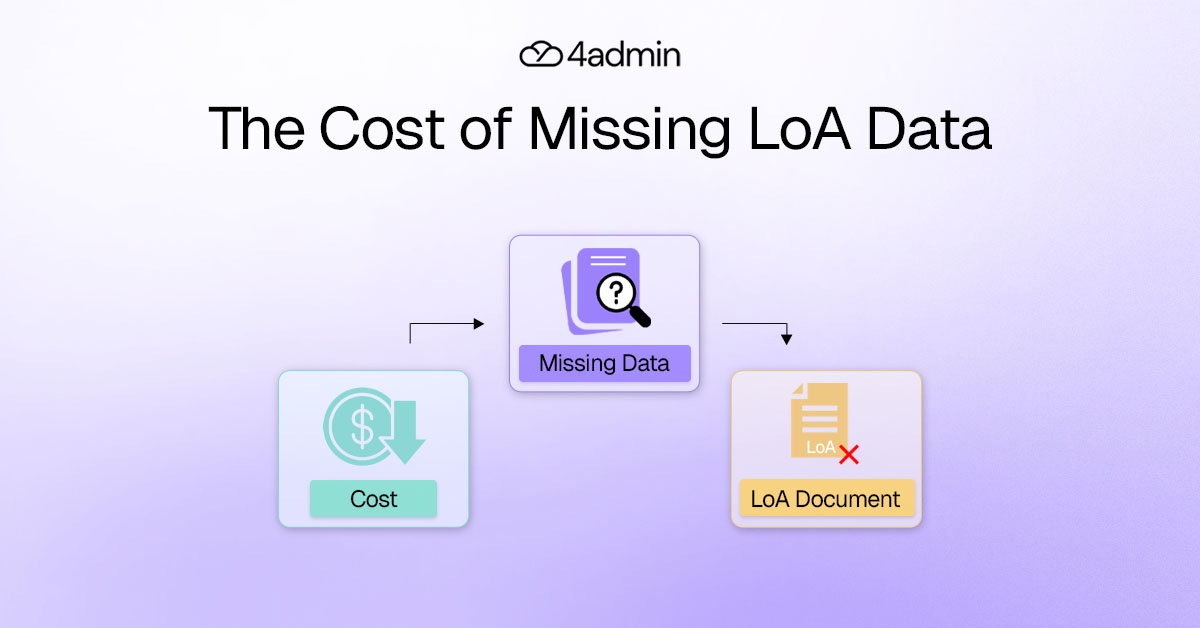
The cost of chasing missing LoA data isn’t obvious until you look at the time lost. It hides inside admin workload, paraplanner effort, delayed advice delivery, and endless follow-up cycles. Each task feels minor on its own. A quick email. A status update, or perhaps another document check.
Over time, those small actions turn into workflow inefficiency, operational cost, and administrative friction that slow the entire firm. This is the real cost of chasing missing LoA data: it is persistent, hard to see, and quietly limits growth.
In this blog, we'll breakdown each hidden cost of chasing missing LoA data that could be limiting your firm’s growth without being noticed.
What “Missing LoA Data” Looks Like in Advice Firms
Missing LoA data is rarely dramatic. It is a familiar loop that usually looks like this:
Information requests come back partially completed, requiring clarification.
Key policy details are missing, outdated, or buried deep inside long PDFs.
Admin teams manually check and re-check documents for these issues.
Paraplanners extract the same information repeatedly, reconciling tables that might not quite match.
Advisers get pulled in to unblock stalled cases or confirm details from memory.
This is not an exception caused by a single provider response latency. It is a routine loop driven by information handoff failures and inconsistent data quality.
Direct Labour Costs That Add Up Fast
Admin time spent extracting, re-keying, and chasing data
Admin teams spend hours trawling through provider packs and pulling out the same fields again and again. When data is missing, they shift from processing to chasing, sending follow-ups and checking portals. Information is often re-keyed into multiple systems, increasing manual effort. Over time, this becomes one of the largest contributors to admin workload.
Paraplanners repeating checks to ensure accuracy
Incomplete or unclear data forces paraplanners to revisit the same data multiple times. Initial reviews are followed by secondary checks once missing information arrives. This repetition is necessary to maintain accuracy but adds no new value. The result is slower throughput and reduced capacity for higher-quality planning work.
Advisers interrupted to resolve gaps or clarify details
When data gaps stall progress, advisers are often asked to step in. They clarify policy details, confirm assumptions, or chase providers directly. These process interruptions break focus and pull advisers away from client-facing work. Even short disruptions add up across a full week.
Per-case costs quietly compounding at scale
Each follow-up or clarification may take a few minutes. Across dozens of cases, those minutes turn into hours. At a firm level, the cost multiplies without being tracked or attributed. What feels manageable per case becomes expensive in aggregate.
What looks like “part of the job” becomes one of the most expensive workflows
As this chasing gets normalised, its cost is rarely questioned. Time spent following up is accepted as unavoidable. Over time, this mindset masks one of the most resource-heavy workflows in the firm. The expense remains hidden because it’s spread across roles.
Indirect Operational Costs and Lost Momentum
Moving beyond wages into flow disruption
The biggest cost is not salary. It is how missing data disrupts the flow of work. Tasks stop and start, priorities shift, and planned timelines break down. This disruption reduces overall output, especially when teams are busy.
Constant follow-ups fragment focus
Chasing missing information requires frequent context switching. Staff move between processing work and sending follow-ups. Each switch reduces concentration and increases mental load. The cumulative effect is slower progress across all tasks.
Context switching slows every other task
When focus is broken repeatedly, simple tasks take longer than expected. Errors become more likely as attention is split. Productivity drops even on unrelated work. The impact spreads far beyond the original case.
Shadow trackers and spreadsheets emerge
To regain control, teams build their own tracking tools. These spreadsheets and trackers sit outside core systems and require constant updating. They add another layer of manual work. Over time, they become critical but unreliable sources of truth.
Backlogs grow without clear visibility
Without a clear view of what data is missing and where cases are stuck, backlogs form quietly. Work appears in progress but does not move forward. Teams stay busy while output declines. The backlog becomes a symptom of deeper workflow issues.
Processing Delays That Stall Revenue
Missing data does not just slow admin work. It delays outcomes.
Onboarding pauses while provider data gaps are chased.
Reviews and transfers stall due to incomplete information.
Advice delivery timelines stretch.
The result? Client experiences delay and uncertainty while revenue recognition slows as cases sit idle.
These delays are rarely attributed to missing data costs directly. They are blamed on providers, complexity, or volume. In reality, incomplete LoA data creates provider response latency that ripples through the entire workflow.
Error Correction and Rework Cycles
Manual workflows increase error rates.
Even when data arrives incomplete, teams move forward anyway. This results in:
Back and forth between admin and paraplanning
Reprocessing once incomplete data triggers missing details.
Corrections take longer than the initial entry because context has been lost.
The same LoA is touched multiple times by different people. Workflow rework loops quietly double the cost of the same case. Rework and error correction tasks consume capacity without delivering progress.
Compliance and Regulatory Exposure
Missing LoA data tends to expose any firm to greater compliance risks because:
Incomplete records weaken audit trails.
Outdated or missing policy data increases Consumer Duty risk.
Manual tracking makes oversight harder, especially when information is spread across emails, spreadsheets, and systems.
Operational cost increases through audits, file reviews, and corrective actions. What began as missing provider data inevitably becomes a compliance issue driven by workflow inefficiency.
Team Burnout, Turnover, and Hidden HR Costs
The human cost is more than often overlooked.
Repetitive chasing drains morale. Skilled staff spend time on low-value administrative friction instead of analysis or client work. Over time, burnout increases with experienced team members leaving, taking process knowledge with them.
Recruitment and training costs rise as replacements are brought in. Admin workload remains high because the underlying data issues persist. The cost continues long after the task is completed.
Strategic Blind Spots Caused by Poor Data
Similarly at leadership level, poor data creates blind spots that firms entirely overlook. With decisions being made on incomplete information, the consequences are:
Capacity planning becomes unreliable because time spent on follow-up cycles and manual reconciliation is invisible.
Growth initiatives stall as bottlenecks appear without clear causes.
Firms struggle to scale without adding headcount because workflow inefficiency remains unaddressed.
Poor visibility into transfer workflows make revenue recognition forecasting difficult.
In a nutshell, bad data leads to bad decisions, even when teams are working hard.
Why the Cost of Missing LoA Data Is Consistently Underestimated
The cost of chasing missing LoA data is always easy to miss, because:
Costs are spread across roles and teams.
Chasing is seen as unavoidable.
Manual work feels cheaper than change.
No single owner measures the full operational cost or the cumulative impact of data follow up effort. What is not measured keeps repeating, reinforced by fragmented ownership and informal workarounds.
Removing the Need to Chase with 4admin
The issue isn’t that teams aren’t trying hard enough. It’s that the work is set up to create chasing in the first place.
4admin handles your LoA data in a more structured way and ensures that the chasing stops being the default response. With 4admin:
Your LoA data is extracted and organised automatically, reducing manual handling.
Teams can clearly see what’s missing, what’s complete, and what’s already been sent.
Visibility replaces inbox checks, spreadsheets, and status chasing.
Centralised workflows replace fragmented follow-ups across people and teams.
Constant back-and forths are minimised as data completeness improves.
The result is simple. LoAs move faster, admin overhead falls, and clients see progress sooner, all without adding headcount.
Conclusion
Chasing missing LoA data is not just inefficient. It is a silent tax on time, trust, compliance, and growth. Firms that absorb the cost pay for it every week through rework, delayed revenue, and rising operational cost.
Firms that address data completeness issues remove administrative friction, reduce risk, and reclaim capacity.
The difference is not effort. It’s whether the workflow is designed to eliminate chasing altogether.
Read Related Articles:
FAQs
How Can Advice Firms Reduce the Cost of Chasing Missing LoA Data?
Firms can reduce the cost of chasing missing LoA data by capturing complete, validated provider information upfront and automating follow-ups, firms cut manual chasing, rework, and admin time.
Are Missing LoA Data Issues a Compliance Risk under Consumer Duty?
Yes, because incomplete or delayed LoAs can lead to poor outcomes, slow service, and inadequate record-keeping under Consumer Duty.
How Does Chasing LoA Data Affect Client Experience?
It creates delays, repeated follow ups, and uncertainty, which clients experience as poor service rather than an internal admin issue.
Why Does Missing LoA Data Cause So Much Rework?
Because teams must repeatedly pause workflows, request information, re-enter data, and restart processes that should have flowed once.
Ready to automate your admin processes?
Learn how you can reduce admin backlog, ensure compliance, and increase capacity.