
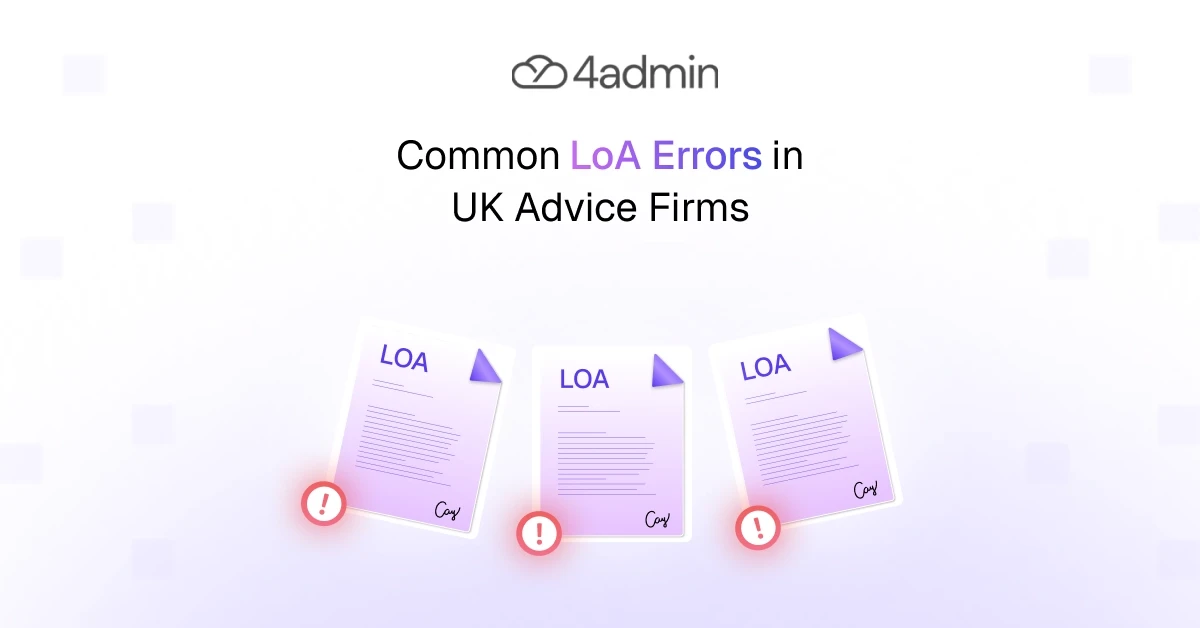
A Letter of Authority (LoA) is a critical part of the financial advice process, allowing advisers to request information from providers on behalf of clients.
Small LoA errors can quickly lead to provider rejection, resubmission, information request delays, longer turnaround time, and a poor client onboarding experience. Common issues include missing signatures, incorrect client details, incomplete LoA forms, and weak follow-up processes.
In many firms, these problems are not caused by carelessness, but by fragmented provider requirements, manual workflows, and inconsistent processes that make LoA handling difficult to manage at scale.
This blog will explore the most common LoA errors UK advice firms make, why they happen, and how firms can reduce delays and operational rework.
The Most Common LoA Errors UK Advice Firms Make
Below are the most common LoA mistakes UK advice firms tend to make:
1. Using Non-Standardised LoA Requests
One of the biggest operational challenges in the LoA process is that providers do not follow one standard format. Different providers require different forms, wording, submission methods, and supporting information.
Some providers require:
wet signatures
specific policy references
adviser firm details
provider-specific LoA forms
portal submission instead of email
A generic Letter of Authority may not meet the provider’s requirements, even if the request looks complete internally. This creates a high risk of provider rejection and resubmission.
In many firms, this is just not an incorrect Letter of Authority problem. The greater underlying factor is that this happens because teams are trying to manage dozens of provider-specific requirements through one manual process.
Also read: The Hidden Costs of Manual LoA Processing
2. Missing or Incorrect Client Information
Incorrect or incomplete client data is one of the most common reasons providers reject an LoA form.
Common issues include:
incorrect client name
outdated address
wrong date of birth
missing National Insurance number
incorrect policy number
provider information mismatch
Even small inconsistencies can prevent providers from matching the request to the correct policy or account. A Letter of Authority may appear accurate internally but still fail because the provider’s records contain different information.
These mismatches often create information request delays and repeated follow-up cycles before the provider can process the request.
3. Missing, Incorrect, or Undated Signatures
Missing signatures remain one of the clearest letter of authority errors across UK advice firms.
Common problems include:
no client signature
missing signature date
only one signature on a joint policy
signature placed incorrectly
electronic signature used where a wet signature is required
Providers treat signature issues as authority and FCA compliance concerns rather than simple formatting mistakes. If authority cannot be verified correctly, the provider may reject or pause the request entirely.
What looks like a small admin issue internally can quickly escalate into extended turnaround time and trigger another resubmission process.
4. Submitting an Incorrect or Incomplete LoA Form
In some cases, the LoA form itself is incomplete, outdated, or incorrectly completed before submission.
Common form-related issues include:
missing adviser firm details
missing FCA number
outdated provider form used
wrong policy type listed
incomplete sections
unclear validity periods
These errors often create immediate provider rejection or clarification requests before the provider even reviews the information being requested.
5. Asking for Information Too Broadly or Vaguely
Some LoA requests fail operationally because they do not clearly specify what information the adviser actually needs.
Generic requests such as “all client information” can create ambiguity for providers. Instead of returning the data required for suitability work, providers will likely send standard packs that do not answer the adviser’s specific questions.
Firms may then need to re-request:
charges
fund holdings
guarantees
exit penalties
contribution history
projections
The request may technically be accepted, but the provider response still fails to support the advice process properly. This creates further delays, follow-ups, and additional provider chasing.
6. Missing Supporting Documents or Attachments
Many providers require supporting documents alongside the Letter of Authority before they will process the request.
Missing attachments may include:
proof of identity
proof of address
client consent evidence
adviser firm authorisation
trust documentation
power of Attorney evidence
Even when the LoA form is signed correctly, the request can still stall if the provider does not receive the supporting information they require.
This creates another cycle of provider queries, resubmission, and administrative rework.
7. Manual or Paper-Based Processing Errors
Manual and paper-based workflows remain one of the largest sources of LoA inefficiency across the industry.
When firms rely on spreadsheets, inboxes, paper documents, and manual data entry, the risk of operational mistakes increases significantly.
Common workflow issues include:
rekeying errors
lost documents
inconsistent checks
duplicate work
missed follow-ups
unclear case ownership
Paper-based processes also make it harder to track where requests are sitting or identify which provider responses are outstanding.
Some LoA errors are not problems inside the document itself. They happen because the workflow around the document is fragmented and heavily manual.
8. Weak Tracking and Inadequate Follow-Up
LoA requests often move between provider portals, inboxes, CRM tasks, spreadsheets, and internal notes.
Without structured tracking, firms may struggle to see:
whether the provider received the request
whether it was accepted
whether additional information is needed
who owns the next follow-up
when the next chase should happen
This lack of visibility creates information request delays and longer turnaround time across onboarding and replacement business workflows.
Even a correct Letter of Authority can become delayed if provider follow-up is inconsistent or poorly managed as we see in several cases.
9. Incomplete Provider Responses
A common operational problem is that providers do not always return all the information firms actually need.
Providers may respond with partial data or standard information packs instead of answering the specific questions requested in the LoA.
This creates additional work because teams must:
review provider packs
identify missing information
ask follow-up questions
wait for another pension provider response.
This is especially problematic in transfer and replacement cases where missing information can delay suitability assessments and recommendations.
The LoA process does not end when the provider responds. The information still needs to be reviewed, validated, and checked for completeness.
Why LoA Errors Matter
LoAs often sit at the beginning of client onboarding and replacement business processes. When a Letter of Authority is rejected or delayed, every stage after it slows down as well.
A small issue such as a missing signature or incorrect client detail can lead to:
repeated follow-ups
resubmission
delayed provider response
slower suitability work
The real cost of letter of authority errors is not the mistake itself. It is the operational time spent fixing the issue, chasing providers, rebuilding incomplete cases, and managing delays across multiple systems.
Why These LoA Errors Keep Happening
Most letter of authority mistakes are caused by workflow fragmentation rather than individual negligence.
Provider requirements are rarely standardised. Different providers use different LoA forms, submission methods, and information requirements.
At the same time, many firms still rely on:
manual checking
spreadsheet tracking
paper-based workflows
disconnected systems
duplicated data entry
Client information is often copied between systems multiple times. Different teams may handle the same case at different stages. Provider responses arrive through multiple channels and formats.
As case volumes increase, the operational complexity grows, but the underlying workflow often remains manual.
Also read: LoA Volume Planning for Growing Advice Firms
This combination creates the conditions for provider rejection, resubmission process delays, and inconsistent handling across the LoA lifecycle.
The Impact of LoA Errors on Advice Firms
Now that you've seen the common LoA errors, here's what the impact of these may look like for your advice firm:
Slower Client Onboarding
Delayed LoAs slow down onboarding, policy document analysis, suitability work, and recommendations. Clients may feel progress has stalled before the advice process has properly started.
More Admin and Rework
Every rejection creates another cycle of checking, correcting, resubmitting, and provider chasing. Admin and paraplanning teams spend significant time repeating the same operational tasks.
Poorer Visibility Across Cases
Without structured tracking, firms struggle to understand where requests are delayed or which provider responses remain outstanding. This makes provider turnaround time harder to manage.
Compliance and Audit Trail Gaps
Weak record-keeping creates FCA compliance and audit trail risks. Firms need clear visibility into:
what was requested
when it was requested
provider responses received
follow-up activity completed
Without a structured audit trail, later reviews and compliance checks become more difficult.
Also read: How LoA Delays Impact Client Trust
How UK Advice Firms Can Reduce LoA Errors
Reducing LoA errors usually requires improving the workflow around the process rather than simply reviewing forms more carefully.
Firms can reduce mistakes by:
using standardised pre-submission checks
maintaining provider-specific LoA requirements
validating client information before submission
checking provider signature rules
making information requests more specific
tracking each LoA from submission to provider response
recording provider communication centrally
reviewing rejected cases for recurring patterns
Moving away from manual tracking toward structured workflows can significantly reduce resubmission process delays and operational inefficiency.
Where Automation Helps in the LoA Process
Automation can help reduce LoA processing time and repeat admin work by structuring how LoAs are submitted, tracked, reviewed, and followed up.
It can help firms:
Identify missing information before submission.
Maintain a clearer audit trail.
Reduce manual rekeying.
Improve data validation.
Support faster provider follow-up.
Improve visibility across cases.
Importantly, automation does not replace human oversight. It helps firms manage the repetitive and operationally heavy parts of the process more consistently.
4admin supports firms by helping structure LoA workflows, identify missing information, support provider follow-up, validate data, and maintain a clear audit trail throughout the process.
To Conclude, LoA Errors Are a Workflow Problem, Not Just a Form Problem
The most common LoA errors UK advice firms make often appear small on the surface, but they create much larger operational delays behind the scenes.
Incorrect client details, missing signatures, outdated LoA forms, vague information requests, missing supporting documents, and weak tracking all contribute to provider rejection, resubmission, and slower turnaround time.
The firms that improve LoA handling most effectively usually do not solve the problem by focusing only on the form itself. They improve the workflow around the process.
Manual LoA processing limits productivity and slows client service. 4admin helps financial firms automate repetitive tasks, improve accuracy, and streamline workflows with Letter of Authority Automation. Let’s book a free call today to see how 4admin fits into your existing workflow.
FAQs
What is a letter of authority?
A Letter of Authority (LoA) is a legal document authorising a financial adviser or third party to request and access a client's investment or pension details from providers on their behalf.
What are the top regulatory errors in LoA handling for FCA-registered firms?
Failing to maintain accurate records, inadequate AML checks on LoA data, and poor oversight of unresolved queries leading to compliance breaches.
How do unresolved LoA liabilities create advice firm exit barriers?
Unresolved LoAs leave behind client data gaps or disputed assets, raising regulatory red flags that block firm sales, mergers, or closures due to due diligence failures.
Is there a systemic FCA issue with ongoing advice tied to poor LoA practices?
No, the FCA's 2025 review found no systemic issues in major firms' ongoing advice, though isolated suitability failures occurred in under 2% of cases.
How can advice firms avoid legacy LoA liabilities eroding business value?
Conduct regular LoA audits, resolve outstanding requests promptly, and document closures to eliminate hidden risks during valuations or exits.
How to outsource LoA chasing without compromising compliance?
Select FCA compliant third-party services with data protocols, retain oversight and ensure all actions are auditable.
What steps fix broken LoA processes in UK wealth management?
Standardise templates, automate data validation, centralise tracking, and train staff on provider-specific requirements to cut errors and delays.
What are the best platforms for automating LoA checks in financial advice firms?
Platforms like 4admin provide services for automated submission, tracking, and compliance validation.
Ready to automate your admin processes?
Learn how you can reduce admin backlog, ensure compliance, and increase capacity.