
As technology decisions continue to become increasingly strategic for financial advice firms, what once felt like a simple decision about software is now shaping how firms operate, scale, and compete.
With more systems involved in daily operations, technology choices increasingly influence efficiency, risk management, and long-term scalability.
This creates an important architectural question for leadership teams:
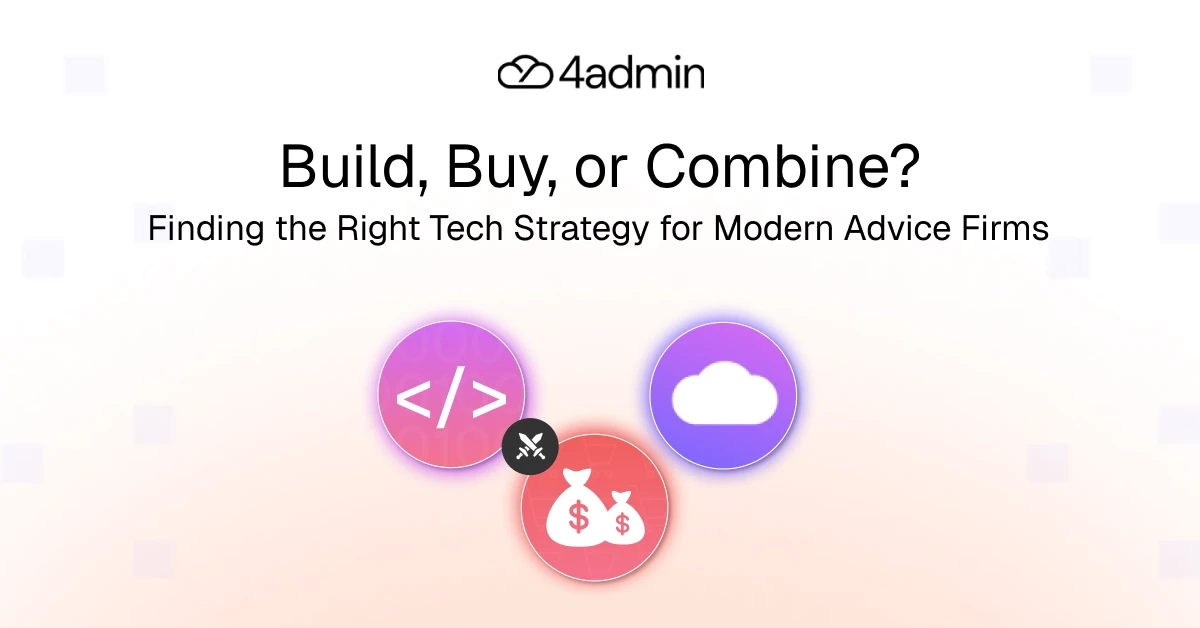
Should advice firms build their own technology, buy platforms from vendors, or combine both approaches?
Stepping outside the build vs buy or hybrid software conundrum, this blog helps you understand the trade-offs between building software, using platforms, and how combining both approaches has become a key strategic consideration for modern financial advice firms.
Should Advice Firms Build or Buy Technology: The Verdict
In practice, many firms discover that neither option fully solves the problem on its own.
With the discussion being often framed as a build vs buy technology debate, they are adopting a hybrid technology model, combining vendor platforms with internal development and integrations.
When to Build: The Case for Building Technology Internally
Some advice firms explore in-house development to gain greater control over their operational systems.
Building software internally can allow firms to:
design workflows tailored to their exact processes.
create proprietary tools that differentiate their service.
control how systems evolve over time.
maintain flexibility around data architecture and integrations.
For firms with strong technical teams, building technology may offer the opportunity to develop capabilities that are closely aligned with their internal operations.
When to Build Software Internally: The Advantages
Understanding when to build software internally is important. Building technology typically makes the most sense when the software directly supports a firm’s unique intellectual property or competitive advantage.
Here are few cases where internal development may be advantageous:
1. Proprietary Investment Models
Firms may build internal systems to support unique investment strategies or portfolio methodologies that differentiate their advice approach.
2. Custom Analytics and Reporting Tools
Internal development can allow firms to create specialised analytics and reporting capabilities tailored to their specific performance metrics and client reporting needs.
3. Internal Dashboards for Business Performance
Custom dashboards can help leadership teams monitor key operational and financial metrics aligned with the firm’s internal decision-making processes.
4. Client Experience Features in Portals or Applications
Firms may develop proprietary client portal features to deliver a differentiated digital client experience that aligns with their service model.
In these cases, the technology often reflects the firm’s own expertise and processes, making customisation more valuable.
The Practical Challenges of Building Systems
However, building operational technology is never simple. Here are the main disadvantages that may follow with time:
1. High Financial Investment
Much of the industry discussions around the build vs buy technology decision often highlight the substantial resources required for internal development. Building software can require significant financial investment.
2. Long Development Timelines
Internal technology projects can take months or even years to design, build, test, and deploy, which may slow operational progress.
3. Ongoing Technical Expertise Requirements
Firms must maintain access to skilled technical teams to support development, updates, and troubleshooting.
4. Continuous Maintenance and System Management
Maintaining internal systems also requires continuous work. Software must be updated, security standards maintained, integrations supported, and infrastructure monitored.
5. Technology May Not Be a Core Capability
For most advice firms, software engineering is not their core business capability. As a result, building large internal systems can become difficult to sustain over time.
This reality often leads firms to consider the alternative approach: buying existing technology platforms.
When to Buy: The Case for Buying Technology Platforms
Because of the challenges associated with internal development, many advice firms adopt off-the-shelf technology platforms to support their operations.
These platforms typically address functions that are common across the financial advice industry.
Examples include:
CRM and back-office systems.
portfolio management platforms.
compliance and record-keeping systems.
operational workflow tools.
Key Advantages of Buying Technology Platforms
1. Faster Time to Market
Vendor platforms usually provide faster time to market. Instead of spending months or years building software, firms can deploy systems much more quickly.
2. Vendor Support and Maintenance
Vendors typically provide vendor support, including ongoing maintenance, security updates, and improvements. This reduces the technical burden on the firm itself.
3. Continuous Product Improvements
Specialist providers often continuously improve their products as regulatory requirements evolve.
Key Limitation of Buying Technology Platforms
However, relying on vendor platforms also introduces one of the biggest rade-offs:
Dependence on Vendor Roadmaps
Advice firms adopting external systems often depend on the vendor’s product roadmap for new features and functionality. This can limit how quickly firms can adapt technology to changing operational needs.
In the buy vs build for financial services debate, this dependency is often highlighted as one of the main considerations when adopting third-party platforms.
The Hidden Challenge: Integration
While buying technology platforms solves many operational problems, it can also introduce a new challenge.
Advice firms rarely operate with just one system. Instead, they often build technology stacks composed of multiple platforms performing different functions.
Typical systems within an advice firm may include:
CRM platforms
portfolio management systems
compliance tools
workflow and document management software
Each of these systems may perform its own role effectively. However, if they are not properly connected, firms can experience fragmented processes.
Without strong integrations, problems can arise such as:
duplicated data entry
inconsistent information between systems
manual work transferring data across platforms
operational inefficiencies between teams
Modern technology stacks increasingly rely on API-first architectures, where systems are designed to exchange data through structured interfaces.
However, simply having APIs is not enough. Firms must also establish clear integration governance, ensuring systems are connected in a structured and reliable way.
Some industry observers refer to the resulting complexity as the “sticky middle.” Firms accumulate multiple tools, but without a clear technology architecture to connect them, operational friction remains.
Related Resource: Integration Architecture for Small Advice Firms
Why Data Ownership Matters
“The most important thing, whether you build or buy, is to own your own data.”
How a firm’s data layer is controlled remains essential to the build vs buy technology debate.
Whether systems are built internally or purchased from vendors, advice firms must ensure they maintain ownership and access to their core data structures.
When firms control their data architecture:
systems can integrate more easily
new tools can be introduced without replacing existing platforms
operational workflows can evolve over time
firms avoid becoming dependent on a single vendor ecosystem
Strong data architecture also influences the total cost of ownership associated with technology decisions.
When systems cannot integrate easily, firms often experience hidden operational costs. Staff may need to manually transfer information between platforms, reconcile data inconsistencies, or maintain duplicate records.
A well-structured data environment allows firms to combine different technologies into a cohesive system rather than operating disconnected platforms.
The Hybrid Model: Combining Build and Buy
Because both building and buying have limitations, many advice firms are adopting a hybrid build buy model.
In this approach, firms combine vendor platforms with selective internal development.
Rather than trying to build everything internally or relying entirely on external vendors, firms design a hybrid technology model that balances control with efficiency.
Typically, this architecture involves:
buying specialist platforms that solve complex operational problems
integrating those platforms into the firm’s broader technology environment
developing small internal tools or integrations where customisation is required
This Hybrid Approach Offers Several Advantages
1. Vendor Expertise
Vendor platforms provide mature functionality, regular updates, and specialist expertise developed for the financial advice industry.
2. Operational Flexibility Through Integrations
Internal integrations allow firms to shape how different tools interact within their own operational workflows.
3. Custom Builds for Specific Needs
In many cases, firms may build custom modules internally that extend existing systems or connect multiple platforms together.
4. A Balanced Technology Environment
This approach combines vendor innovation with the flexibility of internal customisation.
5. A Well-Connected Technology Stack
Instead of replacing existing infrastructure, the goal becomes building a well-connected technology stack that supports the firm’s operations.
How 4admin Fit Into The Hybrid Build Buy Model
4admin is designed to support the hybrid technology model many advice firms are adopting.
Rather than attempting to replace core infrastructure systems such as CRM platforms or portfolio management tools, 4admin focuses on automating the operational workflows that sit between those systems.
4admin helps automate processes such as:
LoA submission and tracking
structured data capture from unstructured documents
provider communication workflows
operational coordination between teams
By operating within an API-first environment, 4admin integrates with existing systems instead of replacing them.
This allows advice firms to maintain their core platforms while introducing automation in areas where manual processes previously slowed operations.
The result is an operational architecture where:
core systems continue managing client records and portfolios
specialised workflow tools handle document processing and data extraction
integrations connect systems into a unified workflow environment
In this way, platforms like 4admin support the broader hybrid build buy model, allowing firms to benefit from specialised automation without needing to build complex internal systems.
Why The Hybrid Approach Is The Way Forward
For large advice firms, the strongest technology strategy is not choosing between building or buying. It is combining both in a way that balances flexibility, control, and speed.
A hybrid model allows firms to benefit from vendor innovation while still shaping technology around their own workflows.
For a deeper breakdown of SaaS adoption, operational trade-offs, and hybrid technology models in financial advice firms, read SaaS vs Custom Software for IFA Firms: Build, Buy, or Hybrid?
Why Combining Build And Buy Works Better
Here's a quick glance at why combining buy vs build for financial services works better:
Attribute | How It Helps |
Access to vendor innovation | Established platforms continue improving their products, adding features and maintaining security, saving firms from building everything themselves. |
Flexibility through internal development | Custom integrations and internal tools allow firms to adapt systems to their specific operational processes. |
Avoiding platform lock-in | Relying on a single all-in-one system can limit flexibility. A mixed approach allows firms to swap or upgrade tools over time. |
Stronger operational architecture | Vendor platforms, internal integrations, and specialist workflow tools can work together to support different parts of the advice process. |
Technology that evolves with the firm | Instead of rebuilding systems every few years, firms can gradually improve their stack as needs change. |
By combining purchased platforms with targeted internal development, firms can create environments that support growth, improve efficiency, and remain adaptable as the industry continues to evolve.
Conclusion: The Question Is Not Build or Buy
For most advice firms, the real decision is not building or buying. It is how to combine both effectively.
The most resilient firms are building technology ecosystems, blending vendor platforms, internal integrations, and specialist tools rather than relying on a single system to do everything.
This hybrid approach allows firms to:
Maintain operational control
Benefit from vendor innovation
Introduce specialised tools where workflows need improvement
Adapt their technology stack as the firm grows
If your firm is exploring how to modernise operations without rebuilding your entire tech stack, it may be time to look at where specialist workflow automation can fit.
FAQs
What are the biggest risks of building technology from scratch for advice firms?
High costs, long timelines, talent shortages, and a 70% chance of budget overruns or failure due to scope creep.
How is AI and emerging tech influencing the build vs. buy decision?
Low-code platforms, APIs, and AI tools like no-code builders make hybrids viable, reducing build barriers while enabling custom tweaks.
When does buying off-the-shelf tech make more sense than building?
For quick launches, limited budgets, or standard needs like CRM/compliance, where speed trumps full customisation.
What are the key pros and cons of building custom technology in-house?
Pros: Total control, perfect fit, competitive edge; cons: Expensive, slow, requires rare expertise, high maintenance.
How can firms successfully combine building and buying (hybrid approach)?
Buy proven core platforms (e.g., CRM), build niche add-ons (e.g., AI notetakers), and use APIs for seamless integration.
Ready to automate your admin processes?
Learn how you can reduce admin backlog, ensure compliance, and increase capacity.